


HousingUK
8 October 2026
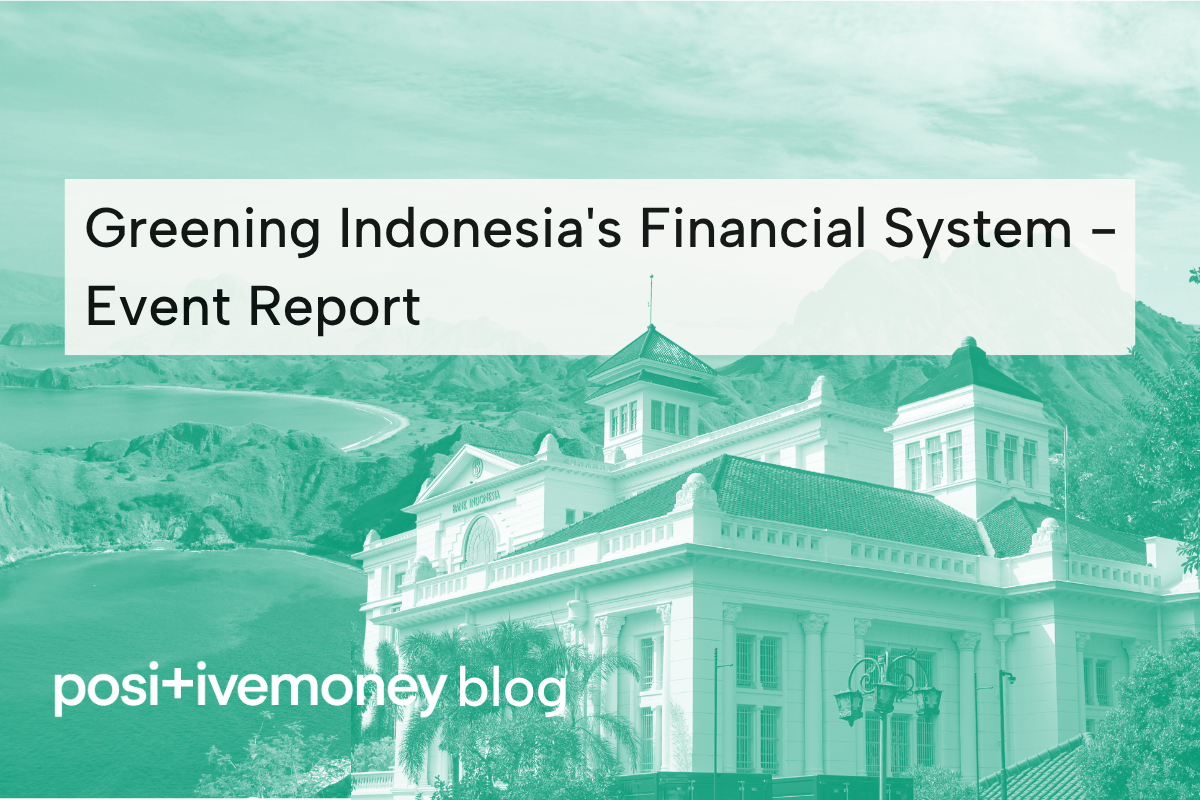
On 4th August 2026, Positive Money brought together civil society representatives from across Indonesia in a webinar to discuss the role of central banking in Indonesia’s green transition.
On 4th August 2026, Positive Money hosted a webinar titled “Greening Indonesia's Financial System” (Menghijaukan Sistem Keuangan Indonesia), bringing together Indonesian civil society partners to examine the state of green central banking and sustainable finance reform in Indonesia. This webinar forms part of our wider work on green central banking in East and Southeast Asia, which has included publishing the first dedicated Green Central Banking Scorecard on the ASEAN+3 group of countries, as well as national level research and engagement work within a selection of key countries, including Indonesia.
The webinar welcomed 39 participants from across Indonesia, including Jakarta, Bogor, Pekanbaru, and further afield, as well as Positive Money staff joining from the UK. A total of 28 organisations were represented, spanning civil society, academia, media, agricultural cooperatives, private-sector ESG practice, faith and philanthropic organisations, and international standard setting bodies, working across a range of environmental and economic issues, and scales, from the local to the national and international level.
The webinar’s chair, Rahmawati Winarni - who has been working with Positive Money to organise the event - framed Indonesia as standing at a defining crossroads: on one hand, holding a strong national ambition to reach high-income status by 2045; on the other, facing climate risk that has also become embedded in inflation dynamics, financial-sector stability, and the direction of long-term development.
The webinar was framed as a space to exchange views on how far Indonesia's current financial structure genuinely channels investment toward sectors needed for green transition, what reforms are needed from Bank Indonesia, Otoritas Jasa Keuangan (OJK), and the Ministry of Finance, and how civil society - in its many roles - can engage and drive accountability in a policy space that has historically been highly technocratic and closed.
Our Co-Executive Director, Sara Hall, gave welcoming remarks, underlining Indonesia's importance within the global green transition and Positive Money's desire to deepen collaboration with Indonesian partners going forward. Joe Herbert, one of our Senior Researchers gave the first presentation, introducing Positive Money, its analysis of concepts including climateflation and fossilflation, and its work on green central banking in Asia. The presentation situated Positive Money’s national-level work - including in Indonesia - as building on the 2025 East and Southeast Asia Green Central Banking Scorecard, in which Indonesia placed joint fourth within the ASEAN+3 for its integration of environmental considerations into its policies.
Indonesia’s highest scoring category in the Scorecard was financial regulation, in large part due to policies of the OJK (the financial supervisor), while monetary policy received a much lower score. The Scorecard praised Bank Indonesia’s recognition of supply-side inflationary shocks and coordination with government departments around inflation target setting, as well as OJK’s integration of climate risk management and stress testing into the supervisory process. It noted that Bank Indonesia should look to further develop green monetary policies, such as establishing a dedicated refinancing facility for green projects, expanding reduced reserve requirements incentives for banks based on the proportion of green loans they extend, and applying environmental risk based collateral framework exclusions and haircuts.
Due to Positive Money’s constructive interactions with Bank Indonesia in relation to the Scorecard, as well as Indonesia’s significance as a major and growing economy, Indonesia became one of our four chosen priority countries for national-level work building on the Scorecard, in 2026. Organising this webinar was a valuable first step towards building a coalition of Indonesian civil society representatives interested in working further on green central banking in the country.
The second presentation, given by Dr. Amri Anjas Asmara of Universitas Gadjah Mada, sought to ground the discussion in the current Indonesian context through empirical data. Dr. Asmara examined how climate change is increasingly recognised as a source of macro-financial risk, and assessed Bank Indonesia and OJK’s readiness to respond. Climate risk was framed using the two-part typology of physical risk (arising from climate hazards interacting with exposure and vulnerability), and transition risk (arising from the shift to a low-carbon economy). In the Indonesian context, the most significant physical-risk channel runs through agricultural supply capacity, which is disrupted by extreme weather. Conventional inflation-targeting frameworks are incapable of addressing climate-driven supply-side shocks, and hence alternative monetary policies need to be adopted.
With approximately 86% of Indonesia's energy supply derived from fossil fuels, and 75% of listed companies by market value falling within transition-sensitive sectors, large volumes of finance are required for Indonesia’s decarbonisation and green transition. However, Indonesia's sustainable finance market remains small relative to its GDP and other major ASEAN+3 economies. Sustainable bond and syndicated-loan issuance stood at roughly US$6.4 billion (0.6% of GDP) over 2017–2021, rising to approximately US$16 billion by March 2026.
The final part of the webinar invited questions and discussion from the civil society attendees. Contributions covered topics such as strengthening Indonesia’s sustainable investment taxonomy to drive green finance, the need for financing to support farmers affected by climate change, and the disproportionate burden of climate damages faced by lower-income groups. Through connecting analytical concepts discussed in the webinar to current lived realities of climate and ecological breakdown in Indonesia, the civil society representatives in attendance highlighted crucial issues which should inform Bank Indonesia’s ongoing development of green central banking policies.
We ended with a statement of intent to build on this initial event with further collaborations between Positive Money and Indonesian civil society, in order to push for the development of green central banking policies in Indonesia which can drive the country’s vital green transition.
Sign-up to our mailing list for regular updates, or make a donation to support our work to redesign our economic system for social justice and a liveable planet.