

EU
17 September 2026
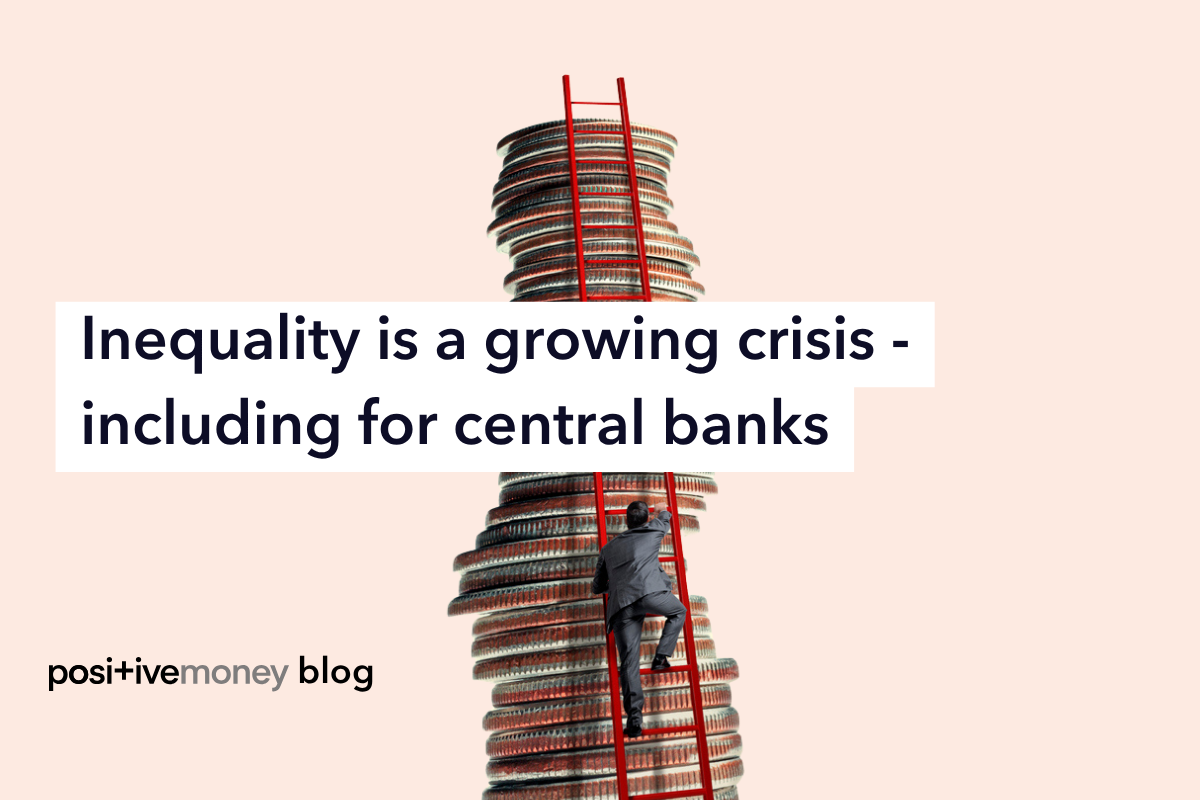
The design of monetary policy can reduce or worsen inequality. But rising inequality also poses an increasing threat to the transmission of monetary policy, and accordingly, the capacities of central banks.
Despite the current context of global multi-dimensional crisis, the super-rich have never had it so good. While much of the world population struggles with poverty and living costs, not to mention escalating ecological breakdown, a small class at ‘the top’ are seeing their wealth proliferate rapidly.
This process is detailed in the World Inequality Report 2026, published in December 2025; the third edition of the flagship series published by the World Inequality Lab based at the Paris School of Economics. The series draws on the work of over 200 expert economists and researchers from around the world in order to track changing global trends in inequality.
The report’s headline findings paint a bleak picture: the wealthiest 10% of the world’s population own 75% of the total wealth, while the wealthiest 0.001% (under 60,000 people) have three times more wealth than the poorest 50%. Crucially, this trend is worsening. In other words, the world is becoming more unequal. The report explains that “since the 1990s, the wealth of billionaires and centi-millionaires has grown at approximately 8% annually, nearly twice the rate of growth experienced by the bottom half of the population”.
This deepening inequality is driving an array of grave problems both nationally and internationally, such as economic instability, deteriorating quality of – and access to – public goods and services (such as housing), an increasingly oversized influence of the super-rich over politics, climate breakdown, and neo-colonial patterns of wealth extraction from the Global South. The World Inequality Report highlights that the wealthiest 10% of the world population are responsible for 77% of global emissions associated with private capital ownership, and 47% of emissions resulting from consumption. Further, it finds that around 1% of global GDP flows annually from poorer to richer nations as a result of differing returns on overseas assets and interest payments on liabilities.
One aspect of the escalating inequality crisis that is subject to much less discussion than those listed above, is what it means for monetary policy. At Positive Money, we have spent much time detailing how monetary policy can itself exacerbate inequality, both within and between countries. This makes it a crucial consideration for central banks. However, it is also true that worsening levels of inequality will pose significant and growing implications for monetary policy. This element of the relationship receives very little attention, and hence is the focus of this piece.
Researchers at the European Central Bank have explained that because “households differ substantially in terms of the composition of their wealth, the sensitivity of their income to the business cycle, and their propensity to consume, the distribution of income and wealth plays a key role in shaping the transmission of monetary policy to economic activity and inflation”. Put simply, the scale and character of inequality in a given economy impacts the effectiveness of monetary policy in achieving its desired objectives.
A significant body of research shows that in societies with greater economic inequality, monetary policy aimed at stimulating economic activity is less effective. This position has also been reaffirmed by high-profile figures in the world of central banking, such as Claudio Borio, the former Head of the Monetary and Economic Department at the Bank of International Settlements (sometimes referred to as ‘the bank of central banks’). But what underlies this relationship between inequality and monetary policy?
A key factor is the ‘propensity to consume’ of different groups. Lower- to middle-income households generally spend a greater proportion of their incomes on goods and services, while higher-income households can cover their needs with much more room to spare, and so are able to set aside leftover cash and save a larger proportion of their incomes. Therefore, while a higher-income household almost always spends more in absolute terms, the propensity to consume of a lower-income household is greater, as a larger proportion of the money they earn is quickly spent again to cover living costs, creating a ‘multiplier effect’ as money circulates through the economy.
Now imagine an economy where a relatively small number of very wealthy households are absorbing the majority of economic gains being generated (i.e. a scenario of rising inequality). This is currently the case in much of the world. In such an economy, expansionary monetary policy will be less effective in boosting economic activity and generating a multiplier effect, as a large proportion of any economic stimulus is hoovered up by the wealthiest and taken out of circulation in the form of savings or investments in financial assets, rather than spending in the ‘real economy’.
On top of this, the lowest-income households in an economy may not be able to take up the benefits of cuts to interest rates in the form of cheaper credit under an expansionary monetary policy programme, as they are often not deemed credit-worthy, or do not have sufficient collateral to provide. At the same time, the highest-income households are also likely to be less sensitive to interest rate changes, because they are wealthy enough that they aren’t compelled to change their behaviour to a significant extent based on interest rates.
Accordingly, as well as being socially (and morally) undesirable for the reasons outlined above, highly-unequal societies pose a risk to the effective transmission of monetary policy, and therefore, central banks’ ability to meet their core objectives including price stability. Consideration of inequality is therefore crucial to the fulfilment of central banks’ primary mandates, as well as in the context of social equity.
Central banks are facing a period of intense political scrutiny, including from the far-right. The currently dominant international regime of independent, inflation-targeting central banking is not well-equipped to fend off such attacks. Central banks need to be able to prove they are serving the public good, and are not just a bunch of unelected technocrats providing cover for politicians and protecting the desired economic conditions of private finance.
This requires shifting to a model of central banking in which these immensely powerful institutions are actively contributing to addressing the most urgent crises facing the world today. Unfortunately, as the World Inequality Report shows, inequality is one of these crises that is only set to worsen, until dramatic action is taken.