


UKGlobal
25 August 2026
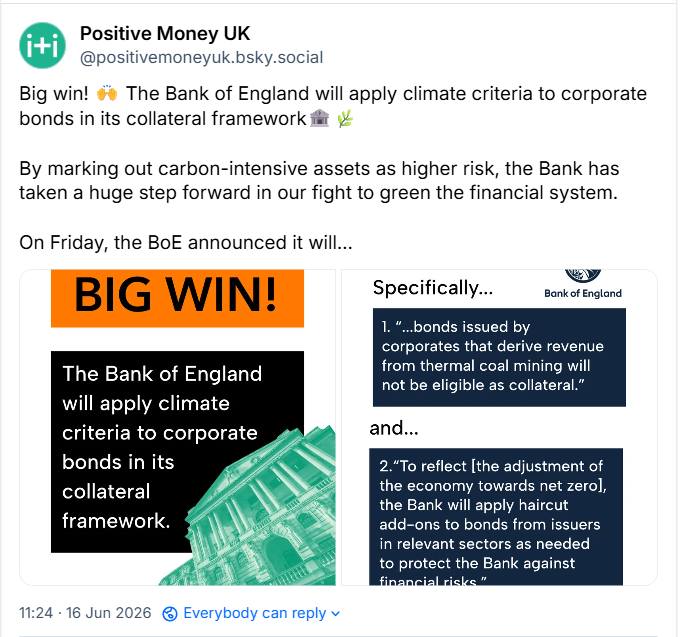
In a significant step, the UK central bank is set to exclude thermal coal mining and better incorporate risks linked to the transition to net zero, to corporate bonds it accept as collateral when lending to banks.
Following years of campaigning, the Bank of England has announced new measures to incorporate climate risk in its collateral framework, in a major step forward in our fight to redesign the economic system for a liveable planet.
The collateral framework sits at the heart of monetary policy. It sets out which assets (like mortgage loans or corporate bonds) financial institutions can use as collateral to borrow from the central bank, and on what terms. Assets that can be used to access central bank liquidity, and on more favourable terms, enjoy a premium in financial markets, meaning the collateral framework shapes the financial system and real economy.
By excluding fossil fuel-related assets altogether, or labelling them as higher risk, the Bank of England could help to redirect billions away from activities driving the climate crisis and towards green alternatives.
In a market notice published by the Bank of England last week, it set out two new climate measures which will come into effect from 31st October this year:
Bonds issued by corporates that generate revenue from thermal coal mining will be excluded from eligibility
Additional haircuts will be applied to corporate bonds from issuers to protect the Bank against climate-related transition risks
Whilst residential mortgages form the majority of collateral pledged by banks, high-carbon corporate bonds are still eligible for use as collateral in many of the Bank of England’s lending facilities, and research suggests eligibility alone has powerful effects.
The Bank of England’s measures send an important message: that carbon-intensive assets are higher risk. Notably, by applying exclusions to a specific sector (thermal coal production) the Bank has set an important precedent for other central banks to follow - that some harmful activities should not be able to be used to borrow from our central bank. The European Central Bank, whose own ‘climate factor’ is due to be implemented this month, has yet to apply blanket exclusions.
The need for policies like these have never been more urgent. As the latest edition of Banking on Climate Chaos revealed earlier this month, fossil fuel financing from the world’s top 65 banks has hit $8.7 trillion over the last decade, whilst the UK suffered the hottest May on record last month.
In a similar victory to the one celebrated by Positive Money Europe last year, when the European Central Bank announced it would introduce a climate factor into it’s collateral framework, this Bank of England’s new policy marks a crucial step towards integrating sustainability into central banking operations.
However, the effectiveness of the new measures will depend on how the additional climate-related haircuts will be calculated, and the extent to which they penalise high-carbon assets. The Bank should also go further by excluding assets from all ‘always harmful’ activities, including all fossil fuel producers, and by integrating other critical ecological factors including nature loss into the collateral framework.
The journey towards fully greening the Bank of England is difficult and still far from over. Wins such as excluding coal from its Corporate Bond Purchase Scheme, and securing a new green mandate back in 2021, are few and far between, which is why it’s so significant and important to share good news like this when it happens - to celebrate the progress that everyone in the movement has made possible.
This victory is a result of years of joint campaigning alongside partners including Reclaim Finance, the New Economics Foundation, Finance Innovation Lab, ShareAction, and many more. We’ll be keeping a close eye for more detail on the design of these measures over the coming months.
Sign-up to our mailing list for regular updates, or make a donation to support our work to redesign our economic system for social justice and a liveable planet.