

The future of moneyGlobal
2 December 2025
After COP30, climate finance for the Global South remains a major challenge. The world should understand this issue not as charity, but as historical reparations. Addressing it requires a profound reform of the international financial architecture, so that climate finance flows do not become a new form of financial subordination.
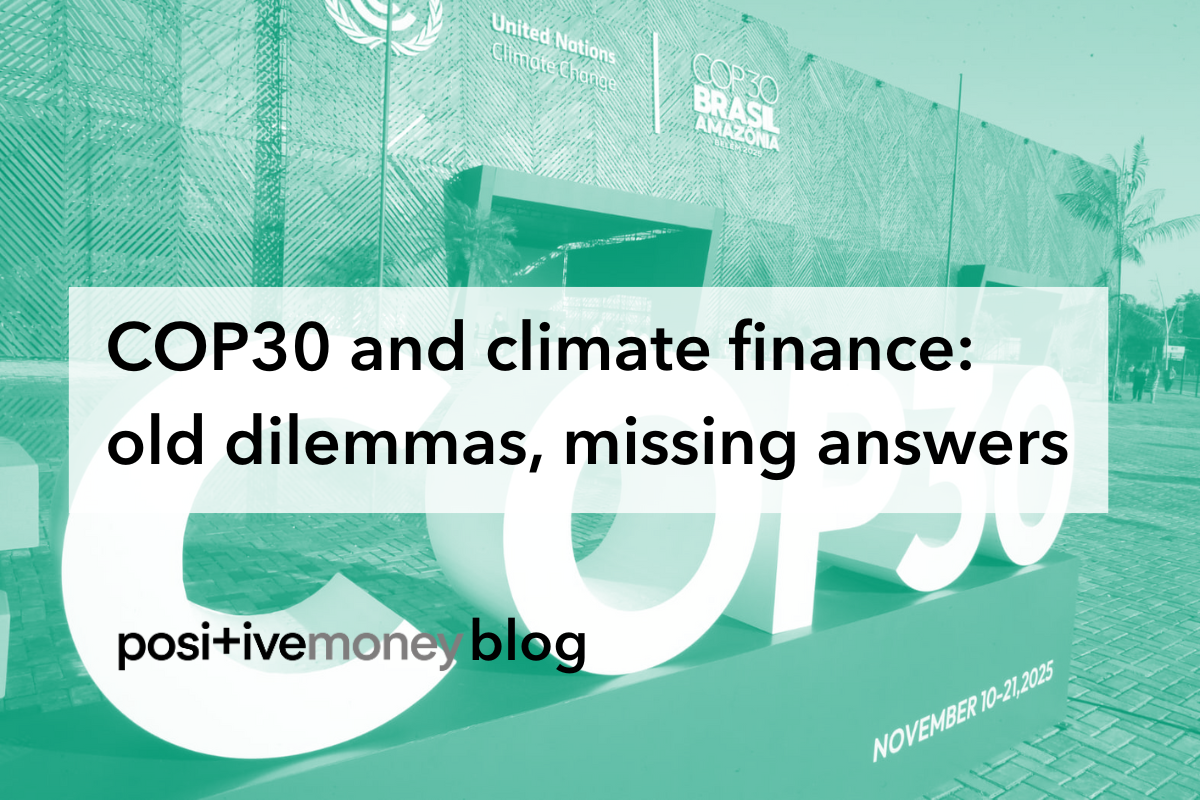
The discussions at COP30 in Belém, Brazil, revolved around longstanding challenges and the persistent difficulty of turning plans and negotiations into effective action. While at COP29 in Baku countries of the Global South had amplified their demands for a higher climate finance goal, COP30 did not bring this issue to the forefront. Although the agreement to triple adaptation finance by 2035 represents a meaningful advance, the $1.3 trillion requested by the poorest nations appeared only as a recommendation in the final report, and debates on the sources, instruments, and mechanisms for delivering these funds were even more limited and less detailed.
The deep social and economic divide between countries remains a major barrier to building a truly global climate agenda. Historically, wealthy countries industrialized and developed using fossil fuels, becoming the main culprits for today’s cumulative greenhouse gas emissions. In contrast, Global South nations, which contributed little to historical emissions, are now the most vulnerable to climate impacts, due to both their infrastructural weaknesses and the constraints posed by a global financial and monetary architecture shaped by colonial legacies.
Crucially, the push for financial transfers from industrialized to low- and middle-income countries should not be seen as “aid” or “charity”, but as historical reparation, a rightful compensation for environmental harm driven by colonial extraction, which now threatens future development in those very countries. This idea echoes the Paris Agreement’s principle of “common but differentiated responsibilities and respective capabilities, in light of different national circumstances”.
Article 9 of the Agreement makes explicit that high-income countries that ratified the treaty must provide financial resources to developing countries to meet their climate goals. In 2009, at COP15, negotiators set the public finance goal at US$100 billion per year (to be reached by 2020); that target was only met in 2022. At COP29 the parties agreed to a New Collective Quantified Goal (NCQG) of US$300 billion per year by 2035, while also calling on the international community to work towards mobilising at least US$1.3 trillion per year, a figure derived from expert assessments of what low- and middle-income countries will need to implement mitigation, adaptation and address loss and damage. Parallel technical work and the COP presidencies produced the Baku-to-Belém Roadmap, a non-binding attempt to map pathways toward that US$1.3 trillion target.
Yet critiques of climate finance targets go beyond the headline numbers. One central problem is where finance actually goes. Global climate finance hit a record high in recent years, but about three-quarters of those flows were concentrated in a handful of regions — principally China, Western Europe and the United States — while private finance increasingly dominated growth. In contrast, international climate finance flowing to low- and middle-income countries was a small fraction of the total: roughly US$196 billion in the most recent comprehensive estimates. Importantly, public actors account for around 78% of that sum, which shows that, contrary to the promise of private “crowding-in,” public finance remains the backbone of flows to the countries that need them most.
However, most of these international public flows to low- and middle-income countries are disbursed as loans, and too often on terms that are priced above market or loaded with conditions that restrict recipient countries’ fiscal policy space. Concessional finance – loans and other instruments offered on softer terms (lower interest rates, longer maturities, or grants) – remains limited: in the public sector concessional lending has represented about 20% of loan volumes in 2023, while within Multilateral Development Banks (MDBs) the concessional share sits near 23% between 2016-2022. Those proportions are far too small to meet adaptation needs or to allow poorer countries the fiscal breathing room required for sovereign-led green transformations.
Another crucial concern is the sectoral allocation of finance. Investment has been heavily skewed toward mitigation projects – especially large-scale renewable energy plants and the electrification of transport (e.g. electric vehicles) – which tend to be more bankable and attractive to private investors. By contrast, adaptation projects receive a very small share of international finance. Adaptation includes vital, often low-profit interventions: resilient housing and basic infrastructure; sanitation and water systems; ecosystem restoration; support and protection for smallholder farmers; coastal defenses; and community-level measures that help people withstand extreme weather events. These interventions are frequently local, distributed, and less likely to generate predictable, tradable cash flows, making them unattractive to standard private capital and poorly served by debt-based instruments.
In short, investment flows continue to favour projects that offer predictable returns and can be financed via debt, and where private capital can capture upside. Yet many of the most urgent adaptation and equity-driven mitigation needs are not “bankable” in that way. Because new sectors and technologies often present liquidity constraints and high perceived risks, donors and MDBs increasingly emphasise de-risking: public guarantees, blended finance structures and credit enhancements that shift downside risk onto public balance sheets while leaving private actors to capture returns. Daniela Gabor has termed this the “Wall Street Consensus”: the expectation that private investors will lead the green transition, with states confined to risk mitigation rather than playing the role of lead investor and coordinator. In this context, initiatives such as the World Bank’s Billions to Trillions agenda and the elevation of blended finance to the status of an unquestionable panacea have gained ground.
That approach is supported by an international financial architecture that reproduces hierarchies: reserve currencies with deep international liquidity (chiefly the US dollar), credit-rating and risk-assessment agencies, and multilateral institutions that often attach adjustment-style conditions to finance. The result is twofold: poorer countries face higher capital costs and restricted fiscal space, while their ability to invest public resources at scale, the very resource needed for sovereign-led ecological transformation and adaptation, is compromised.
Dollar hegemony, and the geopolitical power that comes with it, compounds the problem, and the rise of nationalist and far-right politics in many countries, but especially in the US, further constrains global solidarity. For these reasons, reforming the international financial architecture and democratizing currency and payment systems are urgent elements of any credible climate finance strategy. Adapting communities and reversing the climate crisis requires not only vast sums of money but also fiscal space and domestic capacity to invest, without deepening debt burdens or dependency.
Ultimately, this scenario points to a difficult future. Governments remain heavily influenced by financial markets, which show little willingness to relinquish their extraordinary profits to support the climate agenda. The alternative solution being promoted is to push low-income countries into deeper indebtedness and rely on public budgets and fiscal instruments to mobilise private capital through risk-reduction schemes. The result falls far short of what the climate crisis demands, and a significant risk of rising debt burdens in poorer countries and the emergence of a new form of colonialism, structured around access to critical natural resources and the geopolitics of powershoring.
With the exception of the expanded target for adaptation finance — which does represent a genuine step forward — crucial debates on increasing overall climate finance, scaling up grants and concessional lending, and preventing a worsening debt crisis or a new green colonialism received far too little attention at COP30.
Nevertheless, it is worth emphasising that holding COP30 in Brazil, not only in the Amazon region, but in an urban centre surrounded by the forest, left an important legacy of learning and symbolism. After two editions hosted in countries heavily influenced by the fossil-fuel industry and with limited space for popular mobilisation, COP Belém enabled the international community to experience first-hand the realities and vulnerabilities of tropical regions. The stronger presence of civil society, and especially of Indigenous peoples, created political and moral pressure on governments, reinforcing the need for more ambitious decisions and concrete action.
The Global South has much to offer the world, but it cannot do so while remaining subordinated to an international financial system that restricts its possibilities, constrains fiscal space, and undermines the domestic capacity needed for sustainable development.
Iago Montalvão is an economist who graduated from FEA-USP, holds a Master’s degree in Economic Theory from the Institute of Economics at Unicamp, and is currently a PhD candidate at the same institution. He is the Executive Coordinator of the Transforma-Unicamp think tank and a Researcher at the Institute for Strategic Studies on Oil, Gas, and Biofuels (Ineep). His research interests focus primarily on climate finance, with an emphasis on energy transition, the international financial system, and green finance in China and BRICS.
Sign-up to our mailing list for regular updates, or donate to support our work to redesign our economic system for social justice and a liveable planet.