

Green FinanceEU
10 August 2026
The European Central Bank (ECB) is about to raise interest rates in order to fight inflation. Rate hikes work by cooling demand, but this inflation was caused by energy shocks, not by people spending too much. So here we go again: why use a demand-side remedy for a supply-side disease?
According to media reports, it is practically a certainty that the ECB’s Governing Council will vote for an increase in interest rates during their next meeting on the 10th and 11th of June. The Governing Council is expected to vote for an increase in interest rates of 0.25%, with another similar increase anticipated for September. The expected increase comes at no surprise, with the ECB's own macroeconomic baseline projections being published last March on the assumption that interest rates would be increased twice within the next few months. These expectations were also collaborated by comments from several Governing Council members after the last meeting which took place in May, outlining that an interest rate increase in June was likely to be needed.
The comments reflected concerns towards recent inflationary pressures, in particular that the increases in energy prices are being passed on to the prices of other goods and services. Euro area inflation (on an annual basis) is expected to have risen to 3.2% in May, up from 3.0% in April. This marks the highest annual inflation rate in the euro area since September 2023. Energy prices were the main driver of this increase in prices, increasing by 10.9%, compared with 5.1% in April. There is increasing evidence that the increase in energy prices is leading to second round effects, impacting prices of other goods and services. The annual inflation rate for services stood at 3.0% in May, and at 2.5% for food, alcohol & tobacco, both above the ECB’s target inflation rate of 2.0%.
The increase in energy prices (spilling over to inflation in other goods and services), has primarily been driven by global supply-side disruptions related to the intermittent closure of the Strait of Hormuz, through which roughly 20% of the world’s oil is transported.The current inflationary pressures therefore represent an energy supply-side shock, with instability being imported from outside the euro area. These shocks are becoming increasingly prevalent, driven by geopolitical tensions and the increasing impact of climate change.
The ECB is expected to respond to these inflationary pressures with an interest rate hike, aiming to slow down demand, resulting in deflationary pressures. However, it is widely acknowledged that contractionary monetary policy is a very blunt tool to address energy price shocks, as it does little to address the root causes of the problem.
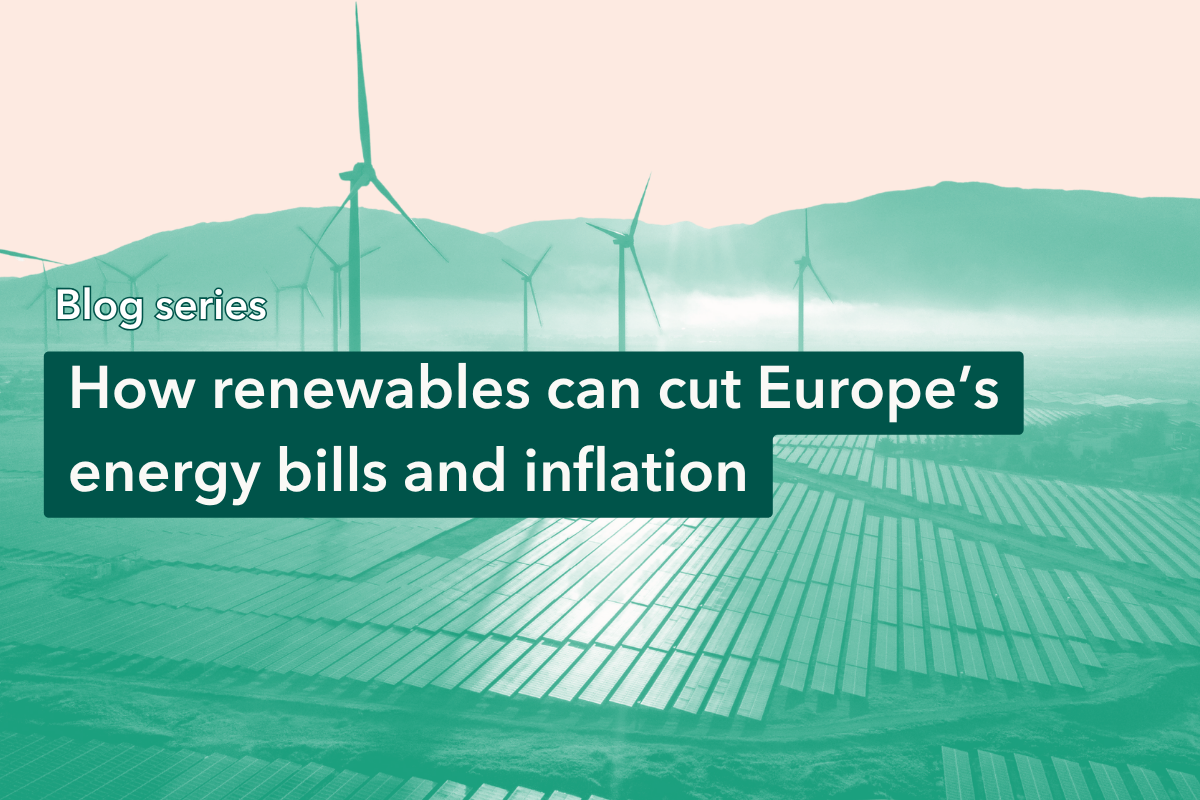
The most effective long-term solution to energy price volatility is not demand suppression, it is the deployment of renewable energy. Wind and solar are not merely a climate tool: they are a price stability tool. As outlined in our recent report, the deployment of wind and solar reduced wholesale electricity prices by an average of 24.2% over the period 2023–2025 across the countries analysed.
Renewables are structurally deflationary. An interest rate hike, by contrast, makes them more expensive to build.
In fact, several studies have shown that an increase in interest rates has a more pronounced detrimental impact on the renewable energy industry (and other green initiatives), relative to fossil fuels. Renewable energy projects typically require a high upfront capital investment, with debt making up a higher proportion of their financing. In contrast, the oil and gas industries, while also highly capital intensive, have far less exposure to the cost of debt, so are less affected by higher rates. Thus, an increase in interest rates ends up disproportionately harming the renewable energy industry, also slowing down the green transition. Interest rate hikes are therefore a short-sighted response to energy price shocks, ultimately harming the long-term structural solutions required which would make the euro area economy more resilient to price instability.
An interest rate hike will also harm the euro area’s long term competitiveness. Cheaper energy from renewable sources is an important factor in increasing the security of supply of energy in the euro area and bringing down costs of production, as outlined in the Draghi report.
Another important factor to highlight is that interest rate increases have a distributional impact, having a larger impact on the more economically vulnerable groups in society. They put downward pressure on wages and lead to fewer jobs being available, especially harming low-income earners. As a result, people suffering the highest burden of the increase in energy prices (and increases in the prices of other important necessities such as food), will also suffer from the impact of an interest rate hike on their income, thus exacerbating inequality.
Even within the ECB, the diagnosis is clear: instead of short-sighted responses to energy shocks, the central bank should focus on the long-term solutions required in pursuit of price stability and competitiveness. As outlined recently by Frank Elderson (Member of the Executive Board of the ECB), Europe’s fossil fuel dependence poses critical risks to price stability. On the other hand, he outlined that meeting the continent’s clean‑energy targets (by supporting clean energy) would weaken the link between volatile global markets and domestic prices. Ultimately, it is a choice between investing in the green transition now or paying more later.
The ECB can and should take on a more active role in supporting the green transition and the clean energy industry. Historically, its operations have indirectly favoured maintaining the status quo of fossil fuels, through its market neutrality rules, which favour corporations with a high market capitalisation. On the other hand, at Positive Money Europe we have long called for the ECB to implement several measures which would support the green transition and assist in its own objectives of price stability. The most prominent is the implementation of a green Targeted Longer-Term Refinancing Operations programme, offering favourable refinancing terms to banks that engage in green lending. This is a green monetary policy instrument that ECB President Christine Lagarde said was under consideration back in 2022. Had such measures been implemented at the time, the euro area economy would be far less vulnerable to the current energy crisis.
We have also recently highlighted that the ECB is at a crossroads in terms of its future ability to support the green transition, given the revision to its operational framework. The resulting changes will limit the ECB’s ability to implement measures aimed at supporting the green transition, and thus it is critical that an alternative design is considered.
The window to act is still open. But it will not stay open indefinitely.