Back to Resources![image]()
20 May 2026
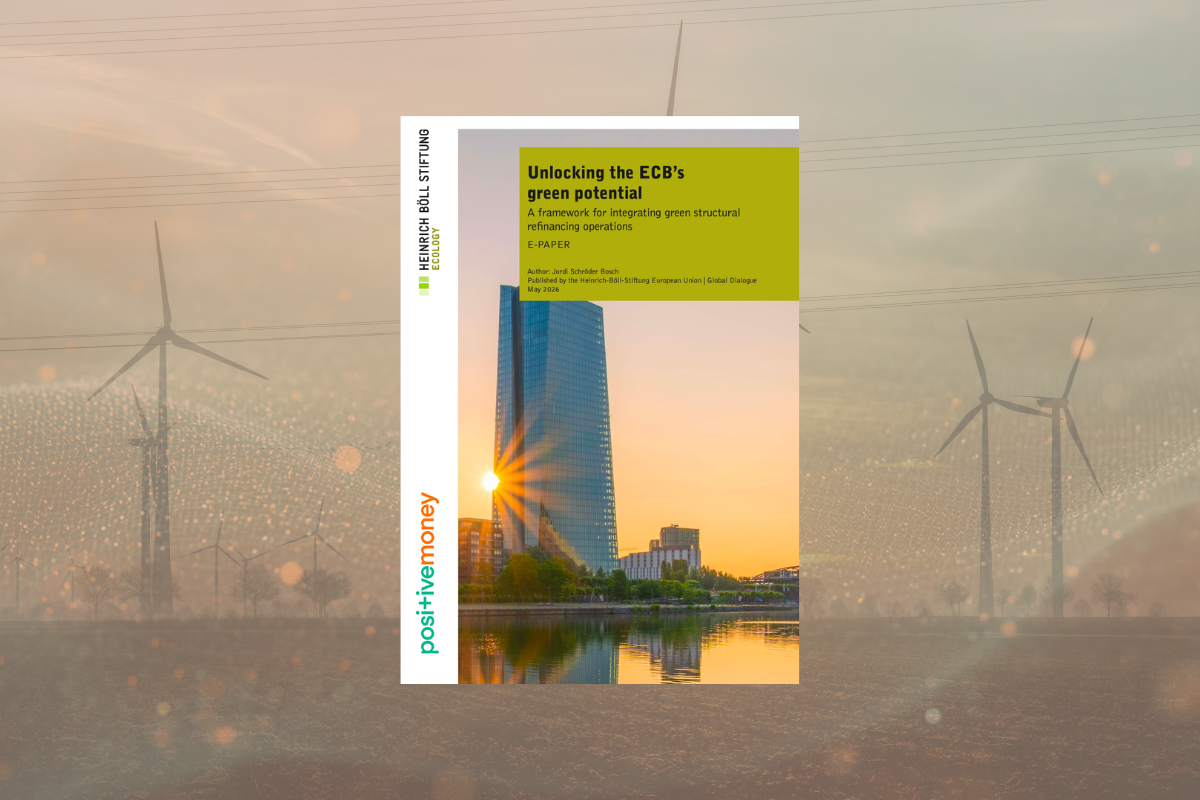
Unlocking the ECB’s green potential: A framework for integrating green structural refinancing operations
As the European Central Bank shifts to a new operational framework, a massive opportunity emerges to steer funds toward the climate transition. Our new report - published with the support of the Heinrich-Böll-Stiftung European Union | Global Dialogue - reveals how the ECB can break free from its self-imposed balance sheet constraints to launch an ambitious green refinancing programme.


In 2024, the European Central Bank (ECB) revised its monetary policy operational framework. Under the new framework, a share of the funding that the ECB supplies to banks will be provided through structural monetary policy operations. Importantly, the ECB has committed to design these operations in a way that supports the transition to a green economy.
This development offers a key opportunity for the introduction of a green structural long-term refinancing operations programme. Properly designed, this programme would reduce financing costs for green investments, which in turn would contribute to closing the existing green investment gap to meet the 2030 emission reduction targets and diminishing the euro area’s fossil fuel dependence.
While this is a positive development, in this report we show that, under the ECB’s revised operational framework, these structural operations will be introduced late, not earlier than 2028, and at a modest scale, reaching only around €200 billion by 2029. Their timing and volume are highly constrained by certain features of the ECB’s proposed operational framework, which aims to keep the ECB’s balance sheet as lean as possible and provide most liquidity through conventional short-term refinancing instruments.
In this report, we propose an alternative operational framework in which structural operations play a much more central role in liquidity provision and the ECB targets a larger balance sheet than what in its proposed framework. This would allow for a timelier and larger scale implementation of structural operations, and, consequently, of a green structural long-term refinancing operations programme.
Finally, the report proposes three different design options for a green structural long-term refinancing operations programme:
Performance-based programme: Funding volumes and preferential rates are contingent on banks’ Taxonomy aligned lending. Banks performing over a pre-defined ambitious benchmark would receive a bonus rate. This programme would incentivise banks to set ambitious Taxonomy aligned lending targets.
Transition plan-based programme: Eligibility is tied to the credibility and benchmarks of banks’ transition plans under the Capital Requirements Directive (CRD). This incentivises banks to adopt ambitious transition plans and implement them effectively.
Collateral-based programme: Access to refinancing is conditional on posting green collateral, such as bonds issued under the EU Green Bond Standard. This would incentivise the issuance of assets that fund green activities.
The current Omnibus legislative package, which aims to reduce corporate sustainability reporting obligations, limits the availability of future Taxonomy aligned data, weakening the information infrastructure needed for the implementation of a green structural refinancing operations programme. While a performance-based programme would be preferable, we offer a broader menu of options from which the ECB could choose, and even sequence among them, depending on their assessed feasibility.
Although the uncertainty surrounding EU sustainability legislation complicates the implementation of such a programme, it remains both possible and necessary for the ECB to follow on its compromise and seize this opportunity.
Read our full report below!