


Green FinanceEU
10 August 2026
For years, central bankers in Frankfurt have hidden behind a convenient myth: the idea that monetary policy is "neutral" and affects everyone equally. But the millions of citizens across the Eurozone living through consecutive economic crises know the truth.
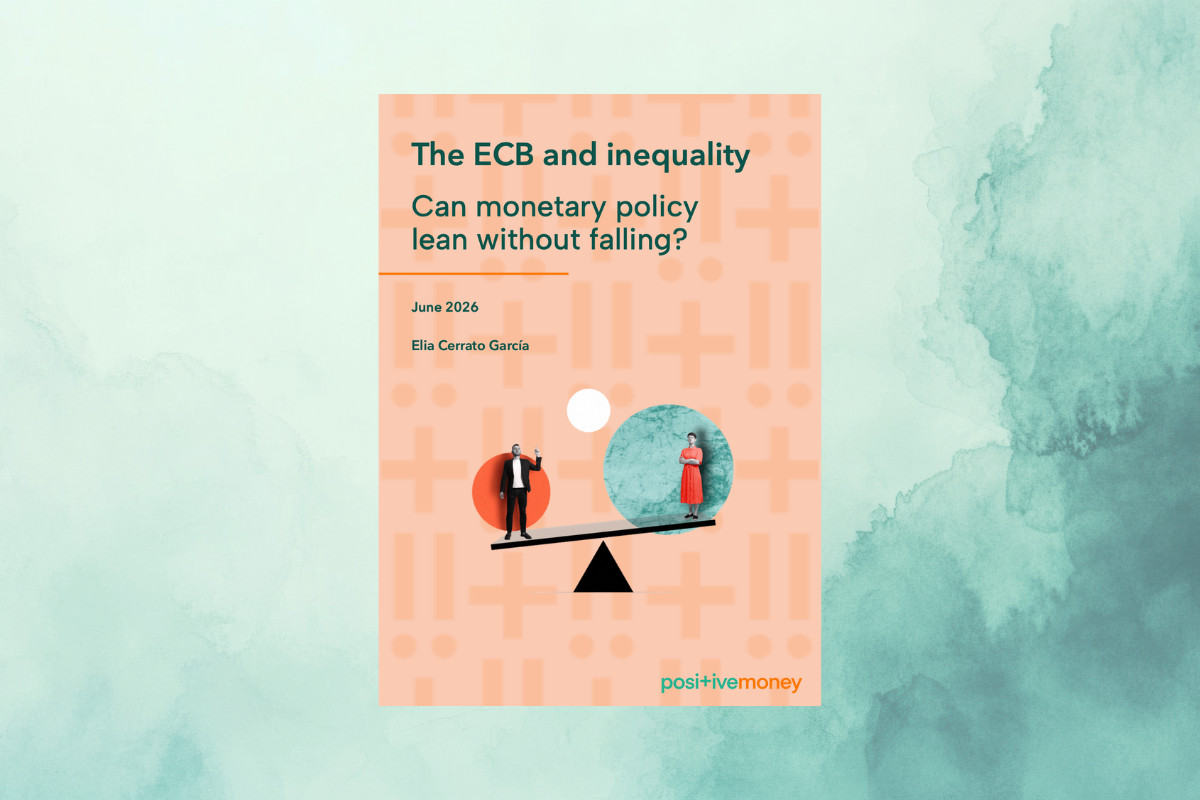
Our new report, “The ECB and inequality: can monetary policy lean without falling?” authored by Elia Cerrato García, tears down this ivory-tower assumption. The data is clear: the Eurozone is deeply divided. Wealth disparities, stagnant wages, and unequal access to credit mean that a single interest rate hike or cut does not hit everyone the same way. In fact, high inequality acts as a giant clog in the economic plumbing, blocking and distorting the ECB's own policies.
Defenders of the status quo always claim that fixing inequality is a job for politicians, not central banks. This report brings new perspectives on the table, by simply reminding that under the EU law the ECB is due to respect the principle of proportionality. In other words, the ECB must balance the measure’s benefits against its side effects.
According to the jurisprudence of the European Court of Justice (CJEU), the ECB cannot simply ignore the massive social collateral damage of its actions. If inequality is actively breaking the way money flows into the real economy, the ECB is not just allowed to act, it is required to design tools that fix these gaps. CJEU argues that the EU institutions, including the ECB, have to reassure that the measure they adopt must be appropriate for achieving the objective (e.g., price stability) and must not go beyond what is necessary. In the case of the ECB this means showing there are no less-restrictive alternatives.
A Roadmap for an inequality- aware central bank
The principle of proportionality is not the only indicator of a healthy and rigorous approach. Being conscious of the impacts of our own activities also represents a key point for European institutions.
To this extent, while the ECB is not a redistributive institution, it cannot ignore inequality when it materially impairs the transmission of monetary policy.
Within this report we are not asking the ECB to become a charity, but we are demanding to empower a realistic, step-by-step battle plan to build an "inequality-aware" setting.
The report outlines a phased agenda for the ECB to integrate inequality considerations into its operations.
We are proposing that:
By 2026: The ECB must publish regular "Distributional impact assessments." The ECB should develop and publish more detailed data regarding the impact of its monetary decisions on income, wealth, employment, and credit access across different groups. No more major monetary decisions without showing exactly who wins and who loses in society.
2026–2028. The ECB may launch real-world pilot programs. For example, rewriting the rules of bank lending so that credit is deliberately channeled to lower-income regions, businesses and families who actually need it to survive, rather than flowing exclusively into financial speculation.
In the long term, should inequality-aware practices become a central and durable part of monetary governance, formal Treaty amendments to explicitly address distributional risks could be explored.
It is time for a monetary system that works for the many, not just the few. Read the full report.