

UKEU
28 September 2026
Our new report explains how the ECB could make green investment more affordable by redesigning its refinancing tools – and why the current operational framework risks delaying crucial climate action.
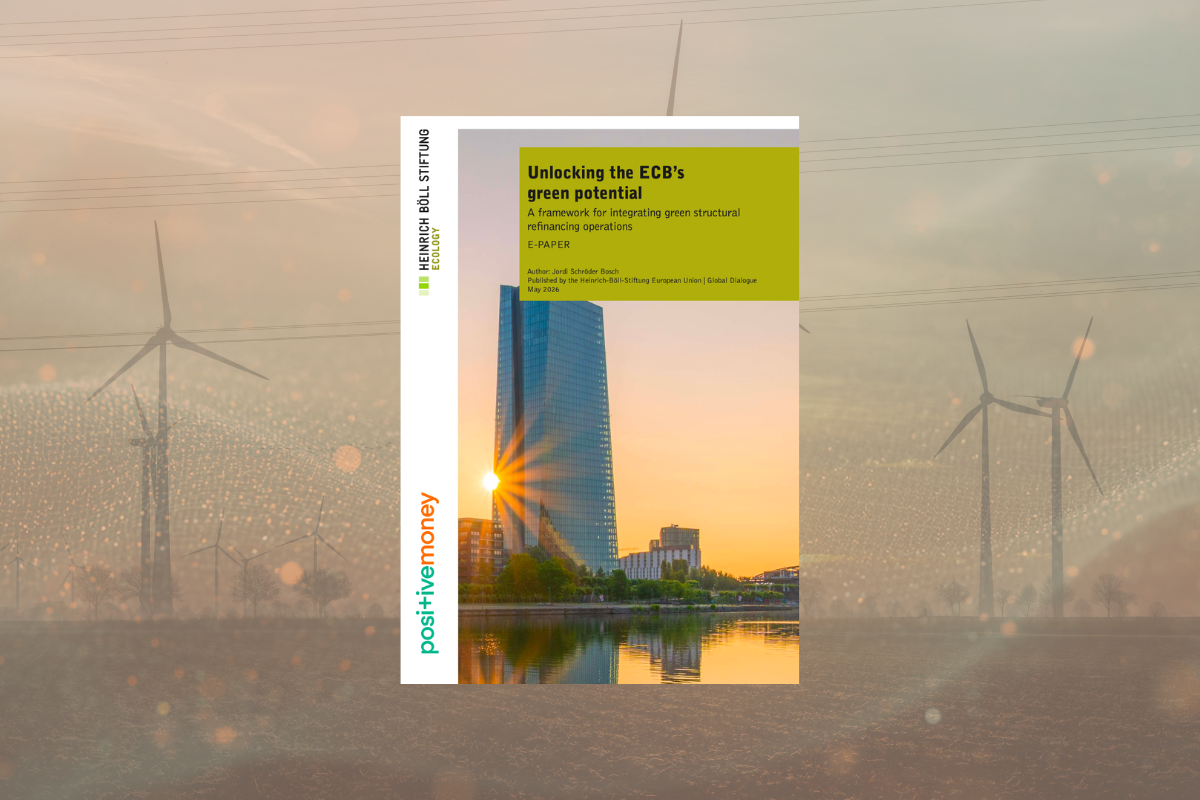
This week, Positive Money Europe and the Heinrich-Böll-Stiftung European Union | Global Dialogue published a new report – Unlocking the ECB’s green potential: A framework for integrating green structural refinancing operations – that shows how the European Central Bank (ECB) could play a much bigger role in making the green transition affordable.
In 2024, the ECB updated its operational framework: the rulebook that decides how it lends to banks and how it keeps interest rates on track. In doing so, the ECB made an important commitment – that part of its funding operations should support the transition to a green economy.
This opens up a real opportunity. By designing a green long-term refinancing programme, the ECB could help bring down the cost of loans for green investments across Europe. Cheaper finance would make it easier to insulate homes, scale clean energy, and reduce the euro area’s dependence on fossil fuels.
However, our report shows that, under the ECB’s current plan, this opportunity could arrive too late and at too small a scale. The new long-term lending tools would not be introduced before 2028, and would only reach around €200 billion by 2029. These limits stem from the ECB’s choice to keep its balance sheet as “lean” as possible and rely mainly on short-term lending – leaving little room for a meaningful green programme.
To address this, the report proposes an alternative operational framework where longer-term refinancing operations play a larger role in providing liquidity. This would allow the ECB to introduce green structural lending earlier, and at a scale that matches Europe’s climate investment needs.
We set out three possible design options for such a programme:
Performance-based: Banks would receive cheaper funding if they increase their lending to activities aligned with the EU Taxonomy, with extra incentives for meeting ambitious targets.
Transition plan-based: Access would depend on the credibility of a bank’s transition plan under the Capital Requirements Directive – namely the EU’s main banking law that sets how much capital banks must hold and how supervisors ensure banks are safely run and able to withstand shocks.
Collateral-based: Banks could obtain cheaper funding by posting green collateral – meaning recognised green assets used as security for a loan – such as bonds issued under the EU Green Bond Standard, which is meant to guarantee that the bond finances environmentally sustainable projects.
The report warns that the EU’s new Omnibus legislative package – which weakens corporate sustainability reporting – could reduce the availability of high-quality green data. This would make it harder for the ECB to run the most ambitious version of a green refinancing programme.
Despite these challenges, the message is clear: a well-designed green structural refinancing programme is both possible and urgently needed. With the right choices, the ECB can turn its commitment to supporting the green transition into concrete action.
Read the full report.