

UKEU
28 September 2026
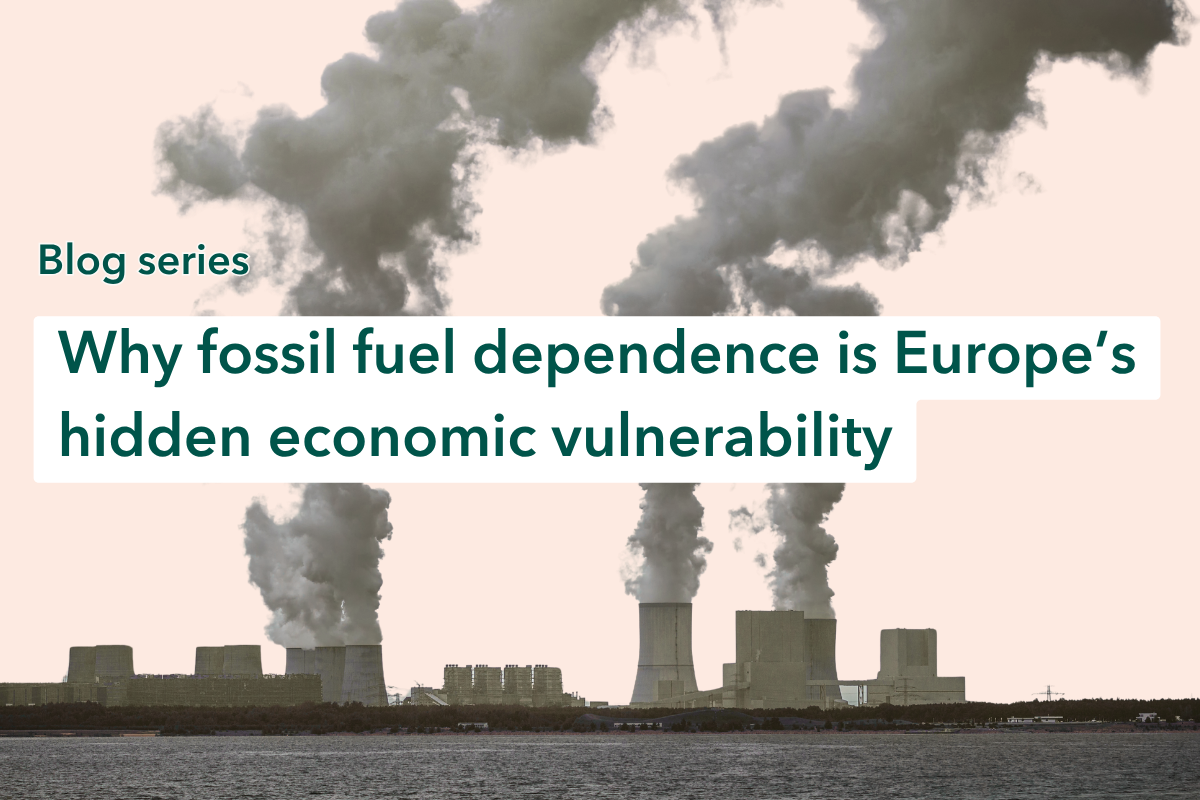
This is the first blog of a series making the financial and economic case for Europe’s clean energy transition. In this article, we look at why Europe's dependence on imported fossil fuels is not just an environmental issue - it is a source of repeated economic shocks, rising costs for people and businesses, and growing geopolitical vulnerability. The series is produced with support from the Heinrich-Böll-Stiftung European Union | Global Dialogue. The views and opinions in this publication do not necessarily reflect those of the Heinrich-Böll-Stiftung European Union | Global Dialogue.
Just over 50 kilometres wide at its narrowest point, the Strait of Hormuz is a stretch of water between Iran and Oman that, until recently, many Europeans couldn't find on a map. But, right now, it is where Europe’s energy future is being decided.
Over the past weeks, escalating tensions around Iran and the Strait of Hormuz have once again shaken global energy markets. Behind the headlines, there are communities facing destruction, uncertainty, and loss. But the consequences travel further than the conflict zone.
Almost immediately, they ripple through global energy markets, pushing up oil and gas prices, fuelling inflation, and putting renewed pressure on households across Europe. For many people, this connection can feel distant. But it becomes very real when energy bills rise again, when food prices increase, and when families are forced, once more, to make impossible choices between heating and eating.
When it comes to energy, Europe remains deeply dependent on fossil fuels it does not control. And that dependence has a price - paid by households, businesses, and European industry every time the world becomes a little more unstable.
The Strait of Hormuz has become a familiar name for a reason. Around a quarter of the world's seaborne oil trade passes through this narrow passage, making it the world's most critical energy chokepoint. When tensions rise there, prices react everywhere.
Fossil fuel prices are set on global markets and so Europe has no influence over what happens next. Whether the disruption comes from the Middle East, Russia, or elsewhere, the outcome is always the same: higher import costs, rising energy bills, lower growth, and renewed pressure on inflation. A geopolitical crisis thousands of kilometres away quickly becomes an economic problem at home.
We have seen this dynamic before - and very recently. When Russia invaded Ukraine in 2022, the human cost was devastating. The shock to energy markets was equally immediate. Gas and electricity prices surged across Europe, triggering a cost-of-living crisis that squeezed businesses and pushed millions of households to the edge. Fossil fuel price shocks accounted for around 60% of peak euro area inflation in the fourth quarter of 2022 - according to Bank of Italy research.
What began as a geopolitical crisis quickly became a social one. Rising energy costs fed into transport, production, food prices, and everyday goods. The burden fell hardest on those already struggling to make ends meet.
What we are seeing today follows the same pattern, and it points to a deeper structural problem.
Fossil fuels are not just another commodity - their prices are shaped by geopolitical tensions, supply disruptions, and global demand dynamics that Europe cannot influence. The more unstable the world becomes, the more unstable Europe’s energy costs become with it. As long as Europe relies on imported fossil fuels, it is effectively outsourcing control over its own inflation – and its own economic stability – to forces beyond its borders.
A recent E3G report makes the systemic nature of this risk clear: even with abundant supply, energy security is not guaranteed. Just weeks before the current crisis hit, market participants were talking about a global oversupply of oil and LNG - that turned into scarcity almost overnight. Disruptions at key shipping chokepoints can cascade rapidly through the whole economy, hitting inflation, trade balances, fiscal spending, and growth simultaneously. Rushing to diversify fossil fuel suppliers, however tempting as a short-term fix, risks locking in the same structural vulnerability for a generation - just with different exporters.
This concern now reaches into monetary policy too. European Central Bank Executive Board Member Frank Elderson, writing in the Financial Times, has acknowledged that Europe's fossil fuel dependence makes it genuinely harder for the central bank to fulfil its core mandate of price stability. As he put it, Europe cannot eliminate geopolitical risk, but it can significantly reduce its exposure to it, by cutting dependence on imported fossil fuels. That an ECB board member is making this argument publicly is itself significant - it reflects how far this has moved from environmental debate into mainstream economic and institutional concern.
As Mario Draghi's competitiveness report confirmed, high fossil energy costs are a key drag on European industry. Every price spike transfers money out of European economies and into fossil fuel exporters. Every new long-term fossil fuel contract is a bet that the next decade will be more stable than the last - a bet that recent history suggests is unwise.
So far, responses to these crises have largely failed to address the root cause.
In the wake of the Ukraine crisis, several European countries temporarily returned to coal or rushed to lock in new fossil fuel supply contracts. Today, similar discussions are emerging again. These measures may ease immediate pressure, but they reinforce the same dependency that caused the problem - and ensure that the next shock will be just as painful.
The same logic applies to the monetary policy response. When energy prices spike, the ECB faces pressure to raise interest rates to bring inflation under control. However, when inflation is being driven by a supply shock – by the price of oil reacting to a crisis in the Strait of Hormuz – raising rates does nothing to address the cause.
Raising rates can theoretically reduce oil demand – but only by slowing the economy so sharply that households and businesses pay the price twice: once through high energy bills, and again through rising borrowing costs and stagnating growth. Higher interest rates make borrowing more expensive across the economy, including for the investments in clean energy and efficiency that would actually reduce Europe's exposure to the next shock. Research shows that a 25-basis-point interest rate hike is associated with a 3.2% drop in wind turbine installations and a 5.3% drop in solar. So the conventional inflation-fighting tool, applied to "fossilflation", ends up delaying the transition that would make future price shocks less damaging. It is another short-term response that entrenches the long-term problem.
There is a growing consensus that the only durable route to energy security is to reduce demand for oil and gas through domestic clean energy, efficiency, and electrification. Not as a climate concession, but as a hard-headed economic and strategic choice. Renewable energy produced at home does not depend on global fuel markets. Its costs are stable and predictable. It keeps money circulating in European economies rather than flowing abroad, and it cannot be used as a geopolitical weapon against us.
That opportunity – and what it would take to finance it at the scale Europe needs – is what we will explore in the next blogs in this series.
For too long, the debate around fossil fuels has been framed primarily as a climate issue. That framing, whatever its merits, no longer captures the full picture.
Europe's fossil fuel dependence is a source of repeated economic shocks - exposing households and businesses to inflation they cannot control, and weakening the industrial competitiveness that European prosperity depends on. It is a geopolitical liability in an increasingly unstable world, limiting Europe's strategic autonomy and leaving it vulnerable to external pressure. It is, ultimately, a social issue - because it is ordinary people who pay the price when energy becomes unaffordable.
Recognising this – fully, and not just in the margins of climate policy debates – is the essential first step. The question Europe faces is not only how to reduce emissions, but how to build an economy that is genuinely resilient: one that protects people and businesses from external shocks, rather than leaving them exposed to them, crisis after crisis.