


EU
5 November 2026
Whether you’re hoping to buy a home, pay for higher education or open that small shop you’ve always dreamed of, a bank’s decision can shape your future. But what if AI makes that decision? A draft report in the European Parliament calls for more of it.
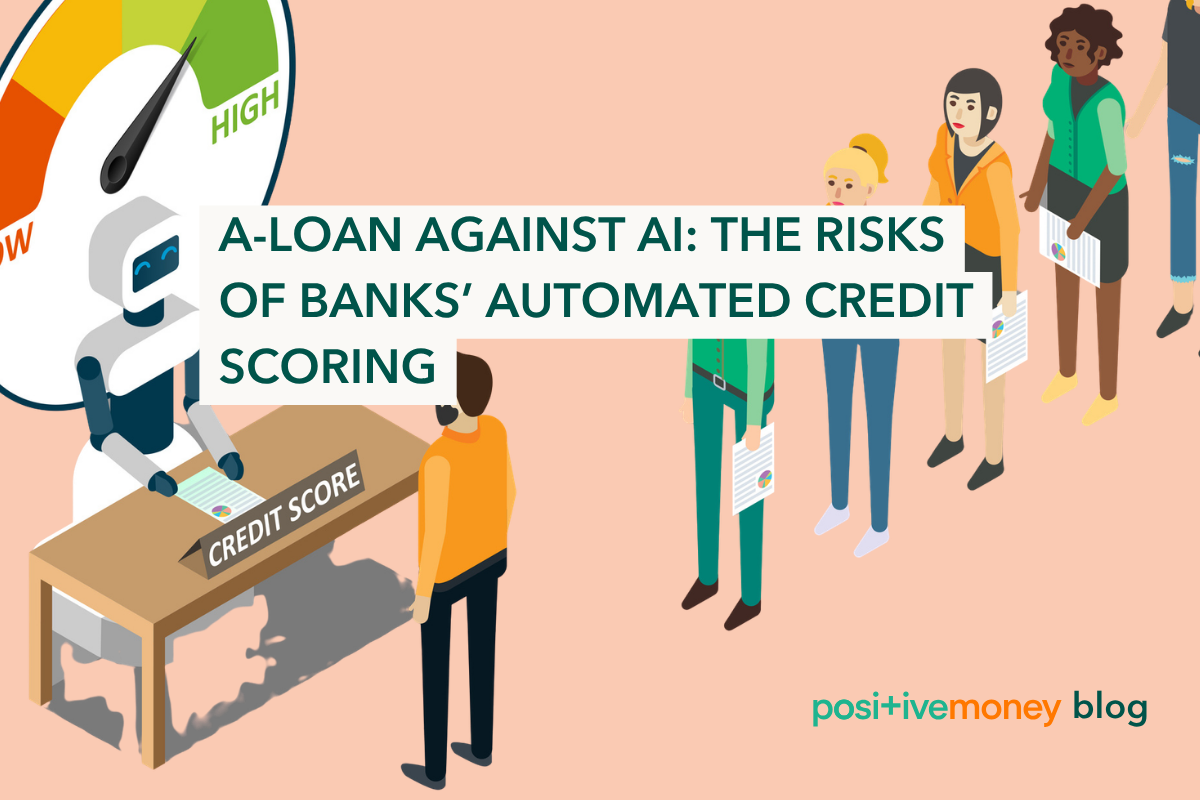
Anyone who has applied for a loan knows the trepidation of waiting for an answer. Whether you’re hoping to buy a home, pay for higher education or open that small shop you’ve always dreamed of, a bank’s decision can shape your future. But what if artificial intelligence (AI) makes that decision? Uncanny, right? Well, that’s already happening - and a draft report in the European Parliament calls for more of it.
The European Parliament is currently discussing a key report by MEP Benjumea Benjumea (EPP) on the competitiveness of the EU banking sector. Although non-binding, the report matters: it will set out Parliament’s response to the European Commission’s own recent report on the topic.
Published in July 2026, the Commission’s report sets out ways to boost the competitiveness of Europe’s banking sector. Yet it never explains what it means by competitiveness, or what a lack of it looks like. Instead, it offers deregulation as a solution, proposing to dismantle safeguards introduced after the 2008 financial crisis to prevent another one.
Parliament’s draft report, published in September, echoes the Commission’s troubling arguments but makes one striking addition. In its section on ‘digital transformation’, it argues that ‘banks should be encouraged to deploy AI in areas such as creditworthiness assessment’ and that ‘innovative use cases can be tested without being prematurely categorised as high-risk under horizontal AI rules’.
At first glance, this might look like yet another case of EU institutions giving in to the AI hype: calling for its adoption in every possible corner of the economy simply because it’s trendy.
But this goes much deeper. Calling for banks to adopt AI while easing its regulatory treatment under the AI Act assumes that deployment is inherently desirable and that the rules are too stringent. The risks and shortcomings of using AI to assess creditworthiness are not mentioned once.
Banks have, in fact, been using AI for credit scoring for years. Concerns about the transparency, fairness and accountability of these systems are already well documented. The European Parliament should know better than to simply encourage their wider use. The question is whether AI helps banks provide fair, productive lending - and whether borrowers are protected when it doesn’t. That should be the test of its contribution to EU banking competitiveness.
When someone applies for a mortgage, a credit card or a small business loan, the bank assesses how likely they are to repay it on time. That assessment, often expressed as a credit score, informs whether the bank grants the loan and on what terms, alongside its business model and appetite for risk.
According to ECB data, around 30% of significant euro area banks already use AI for credit scoring. This doesn’t necessarily mean they use large language models such as ChatGPT or Claude. Credit-scoring systems commonly use other forms of machine learning: methods that learn patterns from data rather than relying only on explicitly programmed rules. These include decision trees, random forests and neural networks.
The promise is that AI can make more accurate predictions by processing larger amounts of data and identifying patterns within them. This could help banks assess repayment prospects more quickly and tailor offers to customers. It’s an attractive promise for institutions that earn interest on their lending.
But if machine learning makes better predictions, we must ask: better at predicting what, for whose benefit, and at what cost?
Assuming that AI will improve financial inclusion and lending conditions for everyone obscures a key fact: AI, like any technology, is not neutral. It is embedded in the socioeconomic context in which it is developed and shaped by human mistakes, systemic biases and business decisions.
For people applying for loans, this raises three closely connected concerns: discrimination, decisions that are difficult to explain, and growing intrusions into their private lives.
Discrimination in credit scoring wasn’t born with AI. But machine learning can reproduce or amplify it through biases in how data is collected, models are trained and results are interpreted.
Research shows that machine-learning credit models can reproduce or deepen existing inequalities in access to finance. Depending on the model and lending context, historically disadvantaged groups, such as women, ethnic minorities and low-income households, may face higher rejection rates or less favourable borrowing terms. More accurate predictions do not necessarily translate into fairer outcomes.
Think of a bank that historically discriminated against women applying for business loans. If it trains a model on records of its previous borrowers, most of whom are men, the model may be less reliable when assessing women’s applications. Past exclusion becomes a weakness in the data used to make future decisions.
Or consider a model that uses postcodes to predict repayment. In areas where residential segregation means postcodes closely track ethnicity, the model may disadvantage an ethnic group without ever using ethnicity directly.
For borrowers, these biases can mean rejection or more expensive loans. For small business owners and entrepreneurs, they can mean losing the chance to start or expand a business. A system that reproduces past exclusion can therefore work against the very objective a competitive banking sector should pursue: financing productive activity across the economy.
A second concern is explainability: whether people can understand how an algorithm arrived at its result. Simpler machine-learning models are relatively easy to interpret; more complex ones operate as ‘black boxes’, making it difficult to explain what drove a particular assessment.
For someone refused a loan, this is a practical problem. Without a meaningful explanation, they may struggle to identify an error, challenge the rejection or understand what could improve their chances next time.
In a February 2025 ruling, the Court of Justice of the European Union clarified that people covered by the GDPR’s relevant automated decision-making provisions are entitled to an understandable explanation of how their personal data was used to produce the result. Simply handing over an algorithm is not enough: the explanation must allow the person to understand and challenge the decision.
Faster assessments are of limited comfort to someone who cannot find out why they were denied credit. Efficiency should also mean identifying and correcting mistakes, rather than making them harder to contest.
A third concern is privacy. Developing these models can involve large amounts of data, creating an incentive for lenders to look beyond traditional financial records. Alternative sources can include information from social media, browsing activity and app use, sometimes obtained through data brokers.
Supporters present this as a route to greater financial inclusion, particularly for people with ‘thin files’: applicants with little or no conventional credit history. Drawing on alternative data, the argument goes, could help lenders assess people who might otherwise struggle to obtain a loan.
But greater predictive accuracy does not automatically justify collecting more personal data. Any benefit must be weighed against the intrusion into borrowers’ private lives and whether comparable results could be achieved with less information. People should not have to surrender more of their privacy simply to gain access to credit.
There is also a competition problem. Better information does not necessarily mean cheaper loans: a lender’s data advantage may strengthen its market power and ability to charge more. If efficiency gains increase banks’ margins without improving lending conditions, whose competitiveness is being served?
The question is therefore whether these systems expand access to fair credit, on reasonable terms and without disproportionate intrusions into people’s lives.
These risks help explain why the AI Act classifies systems used to assess the creditworthiness of natural persons or establish their credit scores as high-risk.
The framework sets out obligations for both providers and users (i.e., banks) of these systems. These include managing discrimination risks, checking data quality and potential bias, documenting how systems work, keeping records and enabling human oversight. It also provides for fundamental rights impact assessments in this area and information for people affected by relevant AI-assisted decisions.
Yet recognising and addressing these risks remains a challenge. A 2022 Bank of Italy survey of selected Italian financial intermediaries found that they needed to strengthen their checks for potential bias, including discriminatory outcomes, as well as their governance arrangements.
That gap reinforces the case for strong safeguards. Borrowers should not have to rely on a bank’s confidence that its systems are fair. They need protections that help prevent discrimination and allow them to understand and question decisions.
This is why the European Parliament’s draft is so troubling. Taking for granted that AI should be encouraged in creditworthiness assessments, while questioning its treatment as high-risk, overlooks the risks and trade-offs involved in this sensitive area.
At best, the draft overlooks a substantial body of research and debate. At worst, it puts banks’ profits before people’s rights.
The Parliament’s final resolution should retain the AI Act’s safeguards for creditworthiness assessments and call for evidence that deployment benefits borrowers. That means examining whether systems reduce discriminatory outcomes, make decisions easier to understand and challenge, and improve access to credit without disproportionate data collection.
It should also judge AI’s contribution to banking competitiveness by the lending it enables. Does it help households obtain fair terms? Does it help viable small businesses access finance? Do efficiency gains reach borrowers?
We should understand competitiveness as the banking sector’s ability to provide long-term, productive lending to the real economy and support people’s quality of life. Parliament should measure AI against those objectives. More AI is not, in itself, an achievement.