

UKEU
18 February 2026
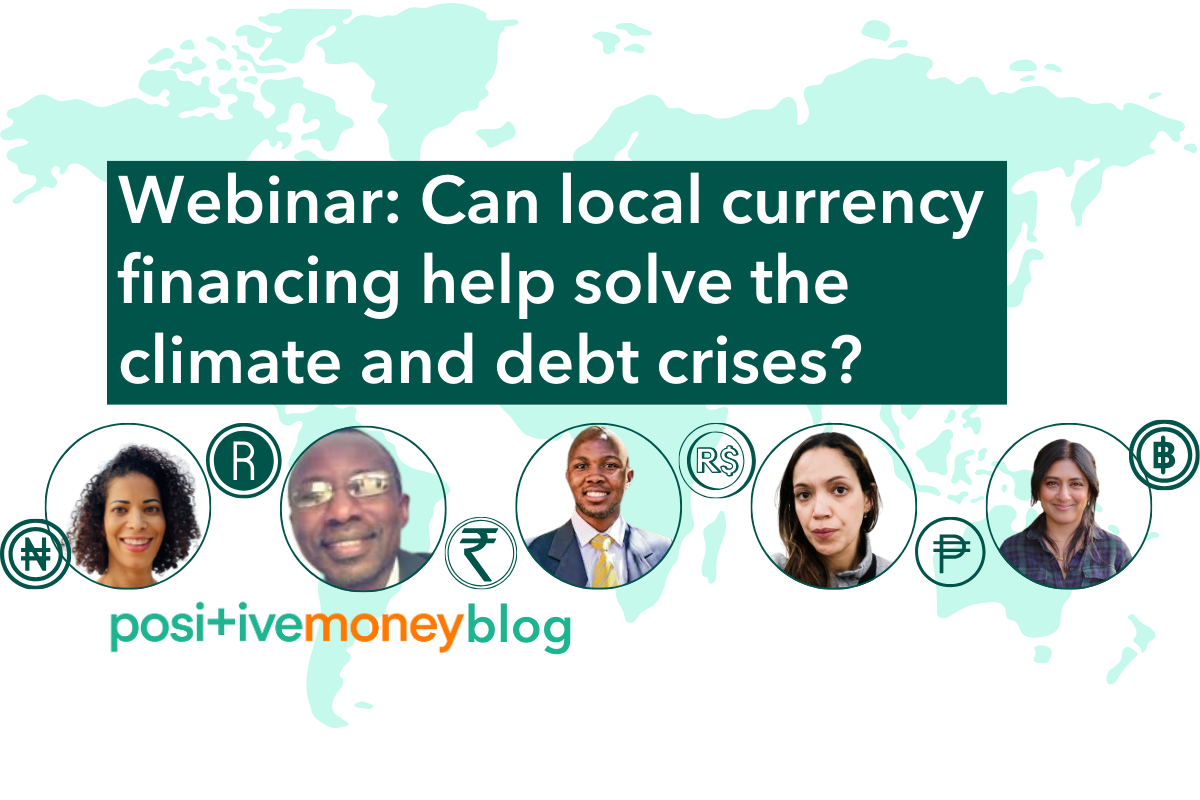
Alongside the Institute for Economic Justice, Positive Money co-hosted a webinar on whether local currency financing can help solve the climate and debt crises.
Alongside the Institute for Economic Justice, we co-hosted a webinar on whether local currency financing can help solve the intertwined crises of debt and climate, which you can now watch the recording of on YouTube.
We know money is far from neutral and that currencies are not created, or treated, equally, as outlined in our report: Beyond Dollar Dominance. By entrenching dependency on a handful of foreign currencies for trade and finance, the global monetary and financial system severely constrains the economic policy space in the Global South to respond to the climate and debt crises. Increasing the use of local currencies is now gaining momentum as a policy approach to build a more resilient and equitable financial architecture.
So, in the face of our international currency hierarchy - which keeps the US dollar fixed on top - the panel explored how countries in the Global South can find credible alternatives to today’s unfair global financial landscape, and what role local currencies can play in tackling the climate and debt crises.
Dr Redge Nkosi, Executive Director of Firstsource Money and Monetary Reform International, set the scene and spelt out the structural inequalities in the international monetary and financial system, and went on to emphasise the need to build domestic capital markets as a counterweight.
Dr Mzwanele Ntshwanti, from the Institute for Economic Justice, spoke to their work on debt crises and emphasised the role of credit rating agencies in increasing the burden on Global South countries, and the impact on human rights and economic justice.
Dr Pepukaye Bardouille, Director of the Bridgetown Initiative and Special Adviser to Prime Minister Mia Mottley, shared insights from their progress in Barbados, and argued that while local currency financing might be more expensive in the short-term, the long-term benefits, including helping to establish a country’s future economic autonomy, are incalculable, and stressed the importance of needing a vision to bring others with you.
Our fourth and final speaker, Fernanda Balata, Associate Fellow at the New Economics Foundation, highlighted their research on ‘The G20 at a Crossroads’, and acknowledged Canadian Prime Minister Mark Carney’s recent speech at the World Economic Forum in Davos, to note that ruptures, like the end of the ‘rules-based order’ - including the reliance on stable financing - can also be opportunities for systemic change.
As the panel’s chair, and our Head of Research, Dr Danisha Kazi, summarised, while local currency financing is certainly not a silver bullet, it is one of many policy tools we can use to actively dismantle current extractive systems, and bring about the changes to the international financial architecture, we all need.
As evident by the insightful panel discussion, increasing the use of local currencies for trade and finance, and strengthening domestic monetary and banking systems, can be understood as vital steps towards a more equitable financial architecture in which Global South countries have the economic policy space to address crises on their own terms. However, this conversation showed that such policy approaches can never exist in isolation, but must be part of wider South-led efforts to build a fairer and more just International Monetary and Financial System that works for all.
Sign-up to our mailing list for regular updates, or make a donation to support our work to redesign our economic system for social justice and a liveable planet.