

Monetary policy and inequalityUK
24 September 2026
Think tank proposes policies as BNM climate conference kicks off in Kuala Lumpur
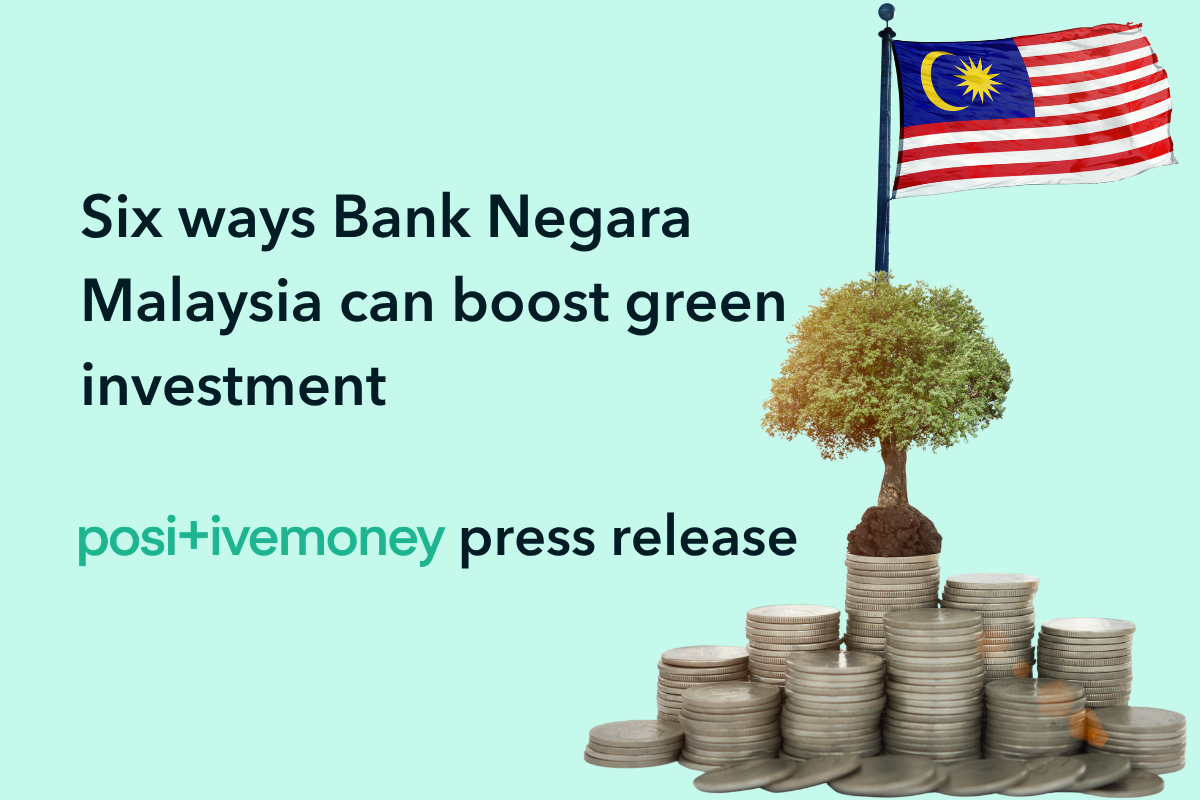
Monday 28 September - International think tank Positive Money has proposed six ways that the Bank Negara Malaysia (BNM) could increase green investment in the Malaysian economy, as the central bank’s two-day JC3 Journey to Net Zero Conference 2026 kicks off today in Kuala Lumpur.
BNM ranked second in Positive Money’s East and South East Asia Green Central Banking Scorecard last year, which looked at how well central banks and financial regulators in the ASEAN+3 are integrating environmental considerations into their policies. But the researchers have now highlighted key policies that the BNM can introduce to strengthen its policies further and maintain its regional leadership position .
1. Relax reserve requirements for banks, to encourage green lending
The first suggestion is that the BNM reduce the amount of money banks are required to hold in reserve if it’s a green project they are lending to, in order to encourage lending to critical infrastructure like renewables. Similar policies have been successfully implemented by the central banks of the Philippines and Indonesia.
2. Provide preferential lending rates to boost green investment
If the central bank lends money to financial institutions at a reduced interest rate on the condition they spend that money investing in green projects, that acts as a huge incentive for them to increase their green investment portfolio. The PBOC has had huge success with such schemes in China, particularly for boosting clean energy infrastructure.
3. Integrate environmental considerations into the collateral framework
The ‘collateral framework’ is the process by which central banks decide what assets they will accept as collateral when they make loans to financial institutions, and what valuation they give those assets. Positive Money recommends that the BNM should consider the environmental impact of assets before deciding whether to accept them as collateral, and when deciding what valuation to give them. The PBOC and Bank of Japan (BOJ) have already begun making progress in this space.
4. ‘Green’ its own investment portfolio
The BNM could take steps to ‘green’ its own investment portfolio, as the Bank of Korea (BOK) has done. The BOK has incorporated tens of billions of dollars of ESG assets into its foreign reserves, while excluding environmentally-damaging assets from coal and fossil-fuel linked companies from its holdings.
5. Coordinate on green policies with other financial regulators
In cooperation with the Securities Commission Malaysia (SCM), the BNM is encouraged to implement green taxonomies (which define what counts as ‘green’ investment), so that there are clearly-defined guidelines for financial institutions to follow when investing, and that both bodies require financial institutions to report how they manage sustainability-related risks.
6. Strengthen research and advocacy partnerships with other countries
Climate change and nature breakdown are global problems, and therefore require a global response. By strengthening ties with other central banks and financial regulators, particularly leaders in the region such as the PBOC, the BNM should be able to mobilise even more finance towards critical clean energy infrastructure and other green projects.
Joe Herbert, Senior Researcher at Positive Money, said:
“Malaysia is highly vulnerable to the devastating impacts of climate breakdown that we are seeing ramping up around the world. Central banks have a hugely important role to play in guiding finance away from high-carbon activities and towards green economic transition.
“In our East and Southeast Asia Green Central Banking Scorecard, we found Malaysia to be a regional leader in green central banking, placing second amongst the ASEAN+3 countries. In order to maintain this leadership position, it is vital that Bank Negara Malaysia continues to strengthen its environmental policies, as other major central banks in the region are doing the same.”
Notes to editors:
The full briefing can be found here: https://www.datocms-assets.com/132494/1789659043-scaling-up-green-central-banking-for-sustainable-economic-transition-in-malaysia.pdf
The briefing is authored on behalf of Positive Money by Chi Xiang Wong, Honorary Secretary of the CFA Society Malaysia.
Positive Money’s 2025 East and Southeast Asia Green Central Banking Scorecard can be found here: https://positivemoney.org/uk-global/publications/east-southeast-asia-green-central-banking-scorecard/
Contact:
For more information please contact Chloe Musto at press@positivemoney.org.uk
About Positive Money:
Positive Money is an international research and campaign organisation working to redesign our economic system for social justice and a liveable planet. Set up in the aftermath of the financial crisis, Positive Money is a not-for-profit company funded by charitable trusts and foundations, as well as small donations from its network of supporters. Find out more: www.positivemoney.org
ENDS