Back to Resources![image]()

31 March 2026
Taking all the credit: Future-proofing money and credit policy for the 21st century
Our report explores how we can safeguard monetary and financial stability for the challenges of the 21st century while facilitating productive investment in the real economy


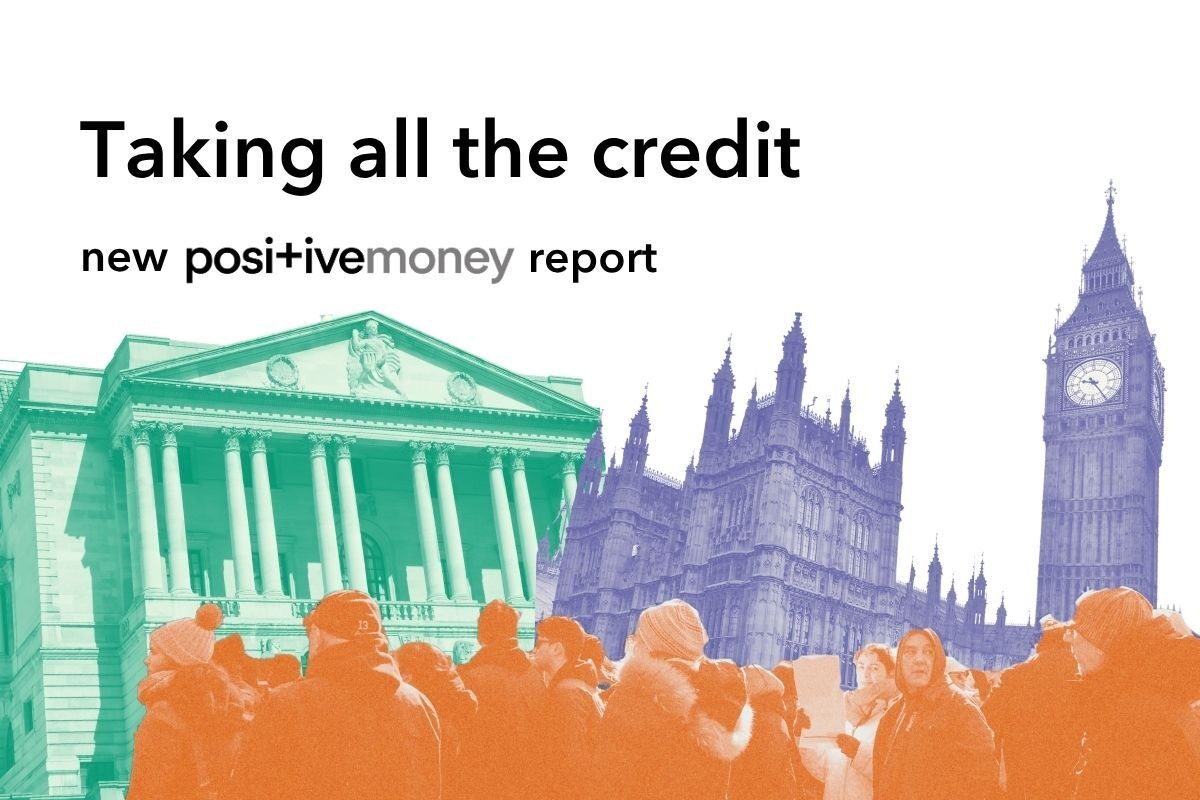
The UK monetary system is a public-private partnership in which private banks create credit that functions as money because the public central bank, the Bank of England, stands behind it. The Bank of England’s power over private banks is based on its monopoly issuance of central bank reserves, the risk-free public money that is the ultimate source of liquidity in the economy.
As the Bank of England drains ‘abundant’ reserves with its reversal of quantitative easing, and the structure of the financial system continues to evolve with the growth of non-bank financial intermediation and new forms of money, the central bank is increasingly ‘open for business’ in lending reserves to a wider range of financial institutions. This necessitates greater public scrutiny of the terms on which the Bank of England uses its balance sheet, to answer the questions of who should benefit from central bank liquidity, as well as what assets should liquidity be provided against, and for what purpose? Or, put differently, on what terms should the public underwrite private credit creation?
Answering these questions requires a more conscious discussion of credit policy - the way in which public authorities guide the allocation of credit. Contrary to the illusion of market neutrality, credit policy already exists, but it currently functions through an intricate regulatory regime that prevents new models of banking and encourages regulatory arbitrage, while incentivising speculative lending for the purchase of existing assets, rather than productive investment in the real economy.
This paper outlines an approach to credit policy that would ensure the Bank of England is able to safeguard monetary and financial stability while supporting the UK economy’s ability to transition beyond a stagnant low-investment model reliant on unsustainable asset price inflation, without sidestepping democratic accountability.
Core to such a regime would be allowing any issuer of money to access central bank funding if they are able to pre-position appropriate assets to cover all of their money-like liabilities. This would ensure uniformity in money and address regulatory arbitrage while facilitating much-needed investment in the real economy. Effectively, any regulated institution could ‘create money’ as long as, in doing so, they are financing new capital investment.
Regardless, as the financial system becomes increasingly reliant on borrowing from the central bank, the Bank of England’s direct influence on the allocation of credit in the economy may unavoidably grow. The Bank should calibrate its provision of liquidity through its collateral framework and lending schemes to support capital-intensive investment that generates new income, such as renewable energy, which is otherwise more vulnerable to changes in monetary policy.
Recommendations
Recommendation 1: HM Treasury should commission a review of the UK’s monetary and financial structures for the 21st century.
Recommendation 2: The Bank of England should require banks and other issuers of money-like liabilities to pre-position sufficient collateral to fully cover demand deposits and other runnable liabilities, rather than imposing holding limits on new forms of money.
Recommendation 3: The Bank of England should calibrate its provision of liquidity, such as through its lending schemes and collateral framework, to support sustainable ‘cash flow’-based investment in new capital formation, while leaning against more speculative financing for the purchase of existing assets based on expected capital gains from asset price inflation.
Recommendation 4: Parliament should be given the opportunity to express a view on which assets the Bank of England should provide liquidity towards by voting on a Preferred Asset Taxonomy.
Download the full report here.
(Free, PDF, 27 pages)
Contact:
Read our press release for the report launch here. For press enquiries, please contact us at press@positivemoney.org.