

UKEU
18 February 2026
The European Parliament’s draft resolution on the European Central Bank (ECB)’s Annual Report argues that climate change is a “political” issue and therefore not part of the ECB’s role. But extreme weather, energy price shocks, and Europe’s dependence on fossil fuels have become major drivers of inflation and financial instability. Climate change is now directly shaping the economic conditions that the ECB is meant to stabilise.
Every year, the European Parliament has a chance to assess the European Central Bank (ECB)’s actions. This is a vital moment of democratic accountability - when an elected body reviews the decisions of a powerful technocratic institution whose policies influence the lives of 351 million people.
Yet this year’s draft report, authored by Belgian MEP Johan Van Overtveldt, contains several concerning points. In our previous blog, we showed how it misunderstands central bank independence. This article addresses another major issue: the report’s insistence that climate change is simply a “political” matter outside the ECB’s role. Paragraph 22 of the report even “underlines the political nature of addressing climate change and protecting the environment”.
This view is outdated and economically misguided. Climate change is already reshaping prices, financial risks, and Europe’s economy.
Climate change is no longer something that sits at the fringes of the economy. It is affecting how much families pay for food and energy, how businesses plan their investments, and how supply chains function. At Positive Money, we have described these dynamics as fossilflation and climateflation:
Fossilflation occurs when food and energy prices rise because our economy depends on fossil fuels like oil and gas, whose prices are volatile, unpredictable, and vulnerable to geopolitical tensions.
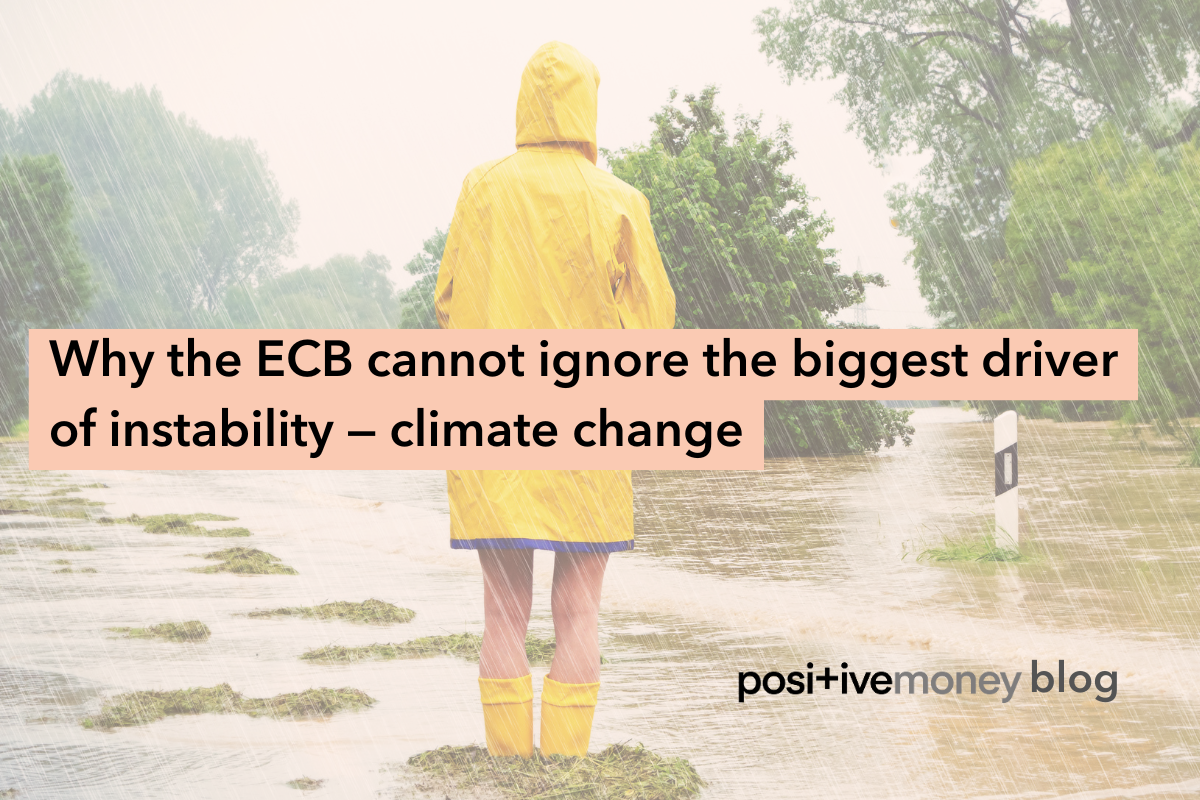
Climateflation describes price increases driven by climate-related events — such as droughts, floods, and heatwaves — disrupting harvests, damaging infrastructure, and reducing productivity.
These concepts are no longer theoretical; they have played out across Europe in real time.
Because Europe relies heavily on imported gas, Russia’s invasion of Ukraine quickly drove energy prices to record levels for households and businesses. At the same time, severe droughts in 2022 and 2023 devastated crop yields in countries like Spain and Italy - contributing to rising prices for fruit, vegetables, grains, and olive oil. Heatwaves also made inflation worse: in the summer of 2022 heat extremes alone added an estimated 0.67 percentage points to food-price inflation. They also reduced hydropower output across southern Europe, tightening energy supply and pushing electricity prices up.
This shows how climate and energy disruptions are now major drivers of inflation - the very thing the ECB is meant to manage.
Under the EU Treaties, the ECB’s primary mandate is to maintain price stability. It cannot meet this mandate if it ignores the climate and fossil-fuel shocks that are now influencing inflation.
The Treaties also give the ECB a secondary mandate to support the EU’s broader economic objectives, including “the protection and improvement of the environment”. This is not optional. To dismiss climate action as “political” is to overlook both the ECB’s legal duties and the economic pressures shaping the euro area today.
So why does the draft report insist that the ECB should hold back from acting on climate change?
Part of the answer is a misunderstanding of what central bank independence actually means. Some MEPs seem to believe that independence requires the ECB to stay away from anything that might be seen as “political”. However, as we’ve seen in our previous blog, independence is about shielding the ECB from political pressure - not about ignoring real economic risks like climate change.
There is also the long-held idea that central banks should be “market neutral”, intervening in a way that doesn’t influence market outcomes. The problem is that markets themselves aren’t neutral. They are already tilted towards high-carbon industries, which issue more bonds and receive more financing than cleaner sectors. When the ECB follows supposedly neutral rules, it ends up reinforcing these old biases.
In practice, this means the ECB’s past bond purchases and even its collateral policies have given more support to fossil-fuel companies than to clean technologies. We see the same pattern in interest rate policy: higher rates make it more expensive to invest in renewable energy projects, while fossil-fuel firms — which often rely less on borrowing — feel far less pressure. This slows down the green transition and leaves Europe more exposed to the very risks the ECB is supposed to help manage.
The reality is simple: the ECB already influences climate outcomes, whether it wants to or not. Pretending that ignoring climate risk keeps monetary policy “neutral” is not credible - it only makes policy less effective and ultimately less responsible.
By framing climate action as “political”, the European Parliament misses an important chance to modernise the ECB’s approach to climate-related risks.
Instead of discouraging the ECB from acting, the Parliament should insist that the ECB:
Treat climate-related shocks as legitimate drivers of inflation and financial instability.
Integrate stronger climate criteria as well as nature and biodiversity criteria into its monetary policy framework, asset purchases, and collateral eligibility.
Ensure that its operations support, rather than undermine, the EU’s broader economic objectives, including environmental sustainability.
Report transparently on how its decisions align with the EU’s climate goals and with the ECB’s own Climate and Nature Plan.
This is not about expanding the ECB’s mandate. It is about fulfilling it - both its primary mandate of price stability and its secondary mandate of supporting the Union’s economic objectives.
What is most concerning is that the European Parliament — the institution responsible for democratic oversight of the ECB — fails to recognise this. Policymakers must urgently update their understanding of the risks facing the ECB and the whole euro area economy - before it is too late.