

Rethinking central bankingEU
16 March 2026
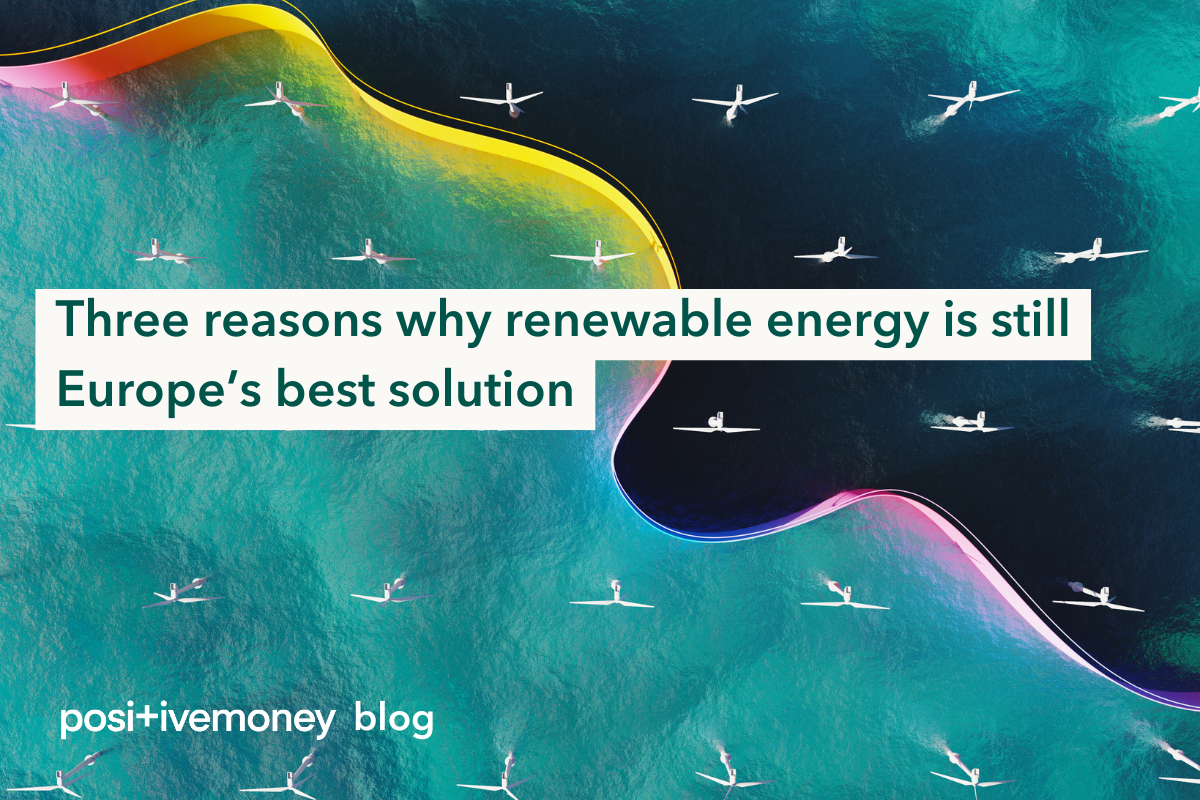
Renewable energy is often discussed as a climate issue, but its impact goes much further. By cutting dependence on fossil fuels, renewables can make Europe more secure, more competitive and better protected from future cost-of-living crises.
The energy system we live with is changing fast. In 2025, wind and solar generated a record 30% of EU electricity, overtaking fossil fuels for the first time on record. This shift can bring clear environmental benefits, like cutting greenhouse gas emissions and improving air quality, but it is also opening up significant economic opportunities. The renewable energy sector has the potential to create millions of jobs across Europe, helping to offset job losses in fossil fuel industries and supporting regional economies during the transition.
However, renewable energy is not only a solution to Europe’s climate challenge. It is also a response to some of the deepest economic and political problems the EU is currently facing. It speaks directly to three issues that dominate today’s policy debates: energy security, industrial competitiveness, and price stability - including the cost of living for households.
Renewables are uniquely positioned to address all three. An energy system built around renewable sources would make Europe less exposed to geopolitical energy shocks, more competitive, and less vulnerable to future social crises driven by sudden spikes in energy and living costs. While this connection is increasingly acknowledged in EU politics, it is still often discussed in fragmented ways. Understanding how these challenges are linked — and how renewables help to resolve them — is essential to shaping a credible economic strategy for the European Union.
Europe’s vulnerability to energy shocks became painfully clear when Russia invaded Ukraine in February 2022. Before then, the EU relied on Russia for approximately 40% to 45% of its gas imports. When supplies were disrupted, energy prices surged across the continent. Gas prices spiked, electricity prices followed, and the shock fed directly into inflation. Central banks hiked their interest rates, governments were forced into emergency measures to shield households and businesses, while public finances came under severe strain.
Since then, the EU has reduced its direct dependence on Russian oil and gas and accelerated renewable energy deployment - though progress has varied across member states. However, Europe remains exposed to new and ongoing geopolitical risks.
Political decisions and conflicts that are beyond Europe’s control continue to shape global fossil fuel markets. These include trade tensions and tariff threats from the US administration and escalating instability in the Middle East - a region that produces around 30% of the world’s oil and 17% of its gas and plays a central role in global energy pricing.
In June 2025, Israel’s bombing of Iran raised fears of a wider regional escalation. In response, Iran’s parliament voted to consider blocking the Strait of Hormuz – a critical bottleneck for global oil and gas flows – but ultimately took no action. Tensions in the area have persisted since then. This month, a US-flagged tanker was challenged by Iranian gunboats in the same strait, underlining how quickly geopolitical tensions can resurface and threaten the stability of global energy markets.
These episodes clearly demonstrate that, as long as Europe depends on imported fossil fuels, it remains vulnerable to forces it cannot control. In other words, energy security under this model is fragile and reactive.
Renewable energy offers a fundamentally different approach. It relies on domestic resources and so it reduces exposure to global fuel markets and geopolitical shocks. A study by the Dutch renewable energy association, NVDE, illustrates how transformative this could be. In an energy system built largely around renewables, the impact on the Dutch economy of a crisis similar to Russia’s invasion of Ukraine would be 80-90% lower than what it has been. By 2050, the study finds that energy price spikes would be far more limited, while GDP impacts would fall from around 3% in 2022 to just 0.3%. Continued reliance on fossil fuels, by contrast, would leave economies structurally exposed to repeated shocks.
Evidence from the recent gas crisis also points in the same direction. Countries with higher shares of renewables in their electricity mix experienced lower price volatility and were better insulated from gas price spikes than those more dependent on fossil fuels. While the EU spent €82 billion on fossil gas during the initial Ukraine war period, the record 13% increase in wind and solar prevented even higher inflation.
Energy costs are a decisive factor for Europe’s industrial competitiveness. Although gas and electricity prices have fallen since their peak in October 2022, reached after Russia’s invasion of Ukraine, they remain structurally higher than in Europe’s main competitor economies - particularly the US and China. In 2023, industrial electricity prices in the EU were 158% higher than in the US, while gas prices were 345% higher. Unsurprisingly, when asked in 2024, EU companies identified energy costs as the second most significant barrier to investment. For many firms, the issue is not just high prices, but unpredictable prices, which make long-term planning and capital investment risky.
This challenge is structural, as the EU still relies on fossil fuel imports for almost two thirds of its energy consumption. This dependence increases production costs, exposes firms to global price swings, creates uncertainty for investors, and drains purchasing power from European households as large sums flow out of the economy to pay for imported fuels. Competing on global markets while remaining structurally dependent on volatile fossil imports is a losing strategy.
This is precisely the diagnosis set out in Mario Draghi’s recent report on European competitiveness, which has become a key reference for current EU debates on industrial policy, including the Clean Industrial Deal. Draghi’s message is clear: decarbonisation is not a constraint on competitiveness, but a condition for it. Europe cannot rebuild a competitive industrial base without addressing the cost and volatility of energy - and that requires a fundamental shift in the energy system itself.
Renewable energy provides that shift. Over the past decade, renewable technologies have undergone striking cost reductions. Between 2010 and 2024, the cost of generating electricity fell by around 90% for solar PV and 70% for onshore wind. Unlike fossil fuels, renewables have near-zero marginal costs and are not exposed to global commodity markets. As renewables and storage expand, electricity prices become less tied to gas price spikes, reducing volatility across the system.
The impact is already visible in countries with higher renewable presence. According to the Bank of Spain, wholesale electricity prices in Spain in 2024 were around 40% lower than they would have been if solar and wind generation had remained at 2019 levels. At EU level, the International Energy Agency estimates that new solar and wind capacity delivered €100 billion in savings for European consumers between 2021 and 2023, with electricity prices around 8% higher in the absence of these additions.
Renewable energy is not an industrial burden - it is the cheapest domestic energy source that Europe controls, and a critical tool for restoring investment confidence and rebuilding industrial competitiveness.
The recent cost-of-living crisis has been the social expression of the energy shock.
What began as a disruption in gas markets following Russia’s invasion of Ukraine, quickly translated into higher prices for heating, housing, food and other basic necessities. Energy price increases fed directly into inflation: between 2021 and 2023, household energy expenditure rose sharply across the EU, and in 2023, annual inflation for food and non-alcoholic beverages exceeded overall inflation in 33 out of 37 countries in Europe. As a result, millions of households saw their purchasing power eroded in a very short period of time.
The impact of this shock has been highly unequal. Energy costs account for a much larger share of spending for low- and middle-income households than for higher-income groups. When prices rise suddenly, these households have far less room to absorb the shock. EU analysis shows that the surge in inflation increased the cost of living for median households by around 10%, while the incidence of material and social deprivation rose by around 2 percentage points. At the same time, energy poverty — commonly defined as a situation where households are unable to afford adequate heating, cooling or electricity services — and monetary poverty — the share of people living below a minimum income threshold — both increased by around 5 percentage points in the aftermath of the energy crisis.
These effects have not been evenly distributed across the EU. The social consequences have been particularly severe in several Central and Eastern European countries, where incomes are lower and energy costs take up a larger share of household budgets. Low-income households and vulnerable groups — including large families, rural populations, children and the elderly — have been exposed to especially high risks of financial hardship and social exclusion.
Price volatility plays a crucial role in amplifying these problems. In an energy system exposed to sudden shocks, unpredictable energy bills make it difficult for households to plan, while increasing stress, and deepening existing inequalities. Volatility matters as much as the level of prices themselves: even temporary spikes can push households into debt or force difficult trade-offs between essential needs.
Governments also face growing challenges in this context. To prevent social and political breakdown, many were forced to adopt emergency measures such as price caps, subsidies, tax cuts and income support. While these interventions were necessary to protect people in distress, they were also costly, often poorly targeted, and difficult to sustain over time. Repeated crisis management places increasing pressure on public finances and diverts resources away from long-term solutions.
Energy crises are therefore not only economic events. They are social and political shocks that fuel public anger, protests and declining trust in public institutions.
For these reasons, the transition to renewable energy is also a social imperative. By replacing imported fossil fuels with domestic energy sources that have near-zero marginal costs, renewable energy reduces exposure to global price fluctuations and lowers the likelihood of sudden increases in household bills and the cost of living for both individuals and businesses. More stable electricity prices are also a prerequisite for electrified heating, better-insulated buildings and lower long-term housing costs - all key drivers of affordability.
In this sense, renewable energy should be understood as a form of social infrastructure: an investment that protects living standards and strengthens social cohesion. However, this potential will only be realised if the transition is a just transition. This means ensuring that the costs and benefits of the energy transition are shared fairly; that low-income households are supported through targeted measures such as energy efficiency investments and social tariffs; and that workers and communities affected by the decline of fossil fuel industries are supported through re-skilling, job creation and regional investment.
A renewable energy transition that is designed with social justice at its core is more resilient and better equipped to prevent future crises.
Renewable energy delivers on several fronts at once. It cuts emissions, but it also stabilises energy prices, strengthens energy security and stimulates Europe’s industrial competitiveness. By reducing the reliance on imported fossil fuels, renewables lower Europe’s exposure to geopolitical shocks and help prevent the cost-of-living crises that have repeatedly hit households and strained public budgets.
However, despite these benefits, political momentum is weakening in the EU, while a significant investment gap remains in renewables, grids and flexibility - precisely the elements needed to achieve lasting stability. Without sustained investment, Europe risks remaining locked into price volatility and reactive crisis management.
The real choice EU policymakers face is not between climate ambition and economic stability, but between investing upfront in resilience or paying repeatedly for crises later on. Recent experience shows that delaying the transition does not protect Europe - it leaves households, businesses and public finances more exposed. Accelerating the deployment of renewable energy is therefore one of the most effective ways to build a more stable and resilient European economy.