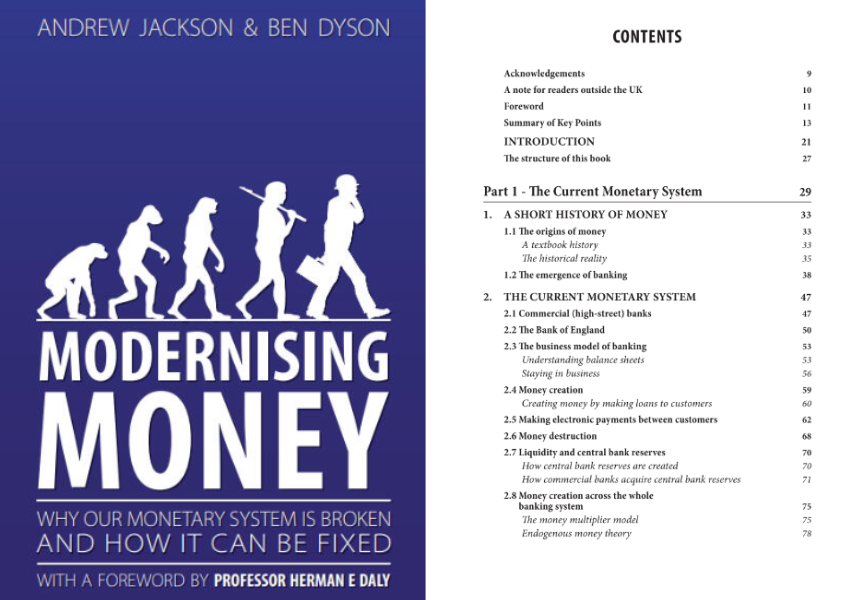
Book Description
Review
"Money is a social invention, indeed among the most important of all social inventions. At present the right to create money has been handed over to the private businesses we call banks. But this is not the only way we could create money and, as recent experience suggests, it may be far from the best one. Read this book with an open mind and you will understand why."
- Martin Wolf, Chief Economics Commentator, Financial Times
"Modernising Money is not just the clearest exposition of the monetary economy available today, it offers realistic pragmatic responses to the most urgent challenge of our time: how to devise a financial system fit for purpose. "
- Tim Jackson, author of 'Prosperity Without Growth: economics for a finite planet
"Modernising Money unveils how the present money system really works, why it doesn't work well, and how it ought to work to the benefit of all."
- Prof. Joseph Huber, Professor of Economics & Environmental Sciences, Martin Luther University, Halle-Wittenberg
"Modernising Money"sets out the authors' solution to the banking quandary with great clarity. The solution, though far-reaching, is not treated as utopian but as a practical proposition: the transition from the present arrangements is dealt with in detail. The authors treats the question of how we might restructure money and banking in the context of a detailed knowledge of UK banking history, institutions and policy up to the present day, and there are examples from other banking systems as well. The book has much to offer, whether you agree with the authors' solution or not."
- Prof Vicky Chick, Emeritus Professor of Economics, University College London
"In Modernising Money, Jackson and Dyson have built on the foundations of Robertson and Huber to develop a thorough and robust blueprint for the transition to a more sensible monetary system in the UK. Their work is at the leading edge of this important field of new economics."
- Tony Greenham, head of business and finance at Nef (the New Economics Foundation) and co-author of 'Where does money come from?'
"This "must read, must act" book lucidly explains two things; the urgent need for a simple basic reform of the money system to make it work more efficiently and fairly for all; and an accessible way for responsible citizens to help make the reform happen."
- James Robertson, author of 'Future Money: Breakdown or Breakthrough?'
Description
Governments across the world have given the power to create money to the private corporations that we know as banks. Today, over 97% of all of the money used by people and businesses is created by banks when they make loans. As Financial Times economist Martin Wolf writes:
"The essence of the contemporary monetary system is the creation of money, out of nothing, by private banks' often foolish lending."
This way of creating money has led to economic instability and a financial crisis. It has produced the highest-ever levels of personal and government debt, made houses unaffordable, and driven the short-termist behaviour which is destroying the businesses, and ecosystems, on which we depend.
But it doesn't have to be like this: we can change the way that money is created. Modernising Money shows how a UK law implemented in 1844 can be updated and combined with reform proposals from the Great Depression. The combined reforms could provide the UK – and any other country - with a stable monetary and banking system, much lower levels of personal and national debt, and a thriving economy.
Detailed, but accessible to non-economists, Modernising Money is written for anybody who wants to know how to create an economy that serves people, businesses, society and the environment.
See more about the book...
Summary
Our banking system is fundamentally broken, yet
for all the millions of words of analysis in the press and financial papers, very little has been written about the core of the problem. While there are many problems with banking, at the root of the issue is that successive governments have ceded to the banking sector the responsibility and authority for creating new money and managing the money supply.
The years following 2007 have clearly shown that we have a dysfunctional banking system. However, the problem runs deeper than that.
It is not just the structures, governance, culture and incentives of banks that are the problem; it is the fundamental method of creating the nation's money supply. We believe it is this process of creating and allocating new money that needs fundamental and urgent reform. This book lays out a workable, detailed and effective plan for such a reform.
In a practical sense there are
five main objectives of the reforms outlined in this book:
- To create a stable money supply which is not based on debt, not issued by private banks and not dependent on the lending behaviour of banks. This money supply would be created by a transparent, accountable, democratic body, in accordance with the needs of the economy as a whole. The process of creating money should be done only in the interests of society as a whole and protected from abuse by either politicians or financial interests. Making these changes would protect the economy from the credit bubbles and credit crunches that have caused so many problems over the last few years, and would limit inflation.
- To create an economy where entrepreneurs, innovators and the real economy can thrive by - as much as possible - ensuring that investment goes to businesses, science and technology, rather than into asset price bubbles or financial market speculation. We hope to see money used for wealth creation rather than simply wealth extraction.
- To reduce the burden of personal, household and government debt, by creating new money, free of corresponding debt, and spending it into the economy to replace the outstanding stock of debt-based money that has been issued by banks. By directing new money towards the 'roots' of the economy - the high street and the real (non-financial) economy - we can allow ordinary people to pay down their debts and stimulate the real economy.
- To re-align risk and reward, so that those who stand to gain from the upside of risky investments also stand to take the downside. Whenever there is a misalignment between the risk and the reward, there will be 'moral hazard' (discussed later) and excessive risk taking by whoever stands to gain from the upside. This problem is rampant in the banking sector and was another major contributor to the crisis. The proposals in this book seek to remove this misalignment of risk and reward.
- To provide a structure of banking that allows banks to fail, no matter their size. With the current structure of banking no large bank can be permitted to fail, as to do so would also bring down the entire payments system, leaving millions of people with no access to money. Simple changes outlined in this book would ensure that banks could be liquidated whilst ensuring that customers would keep access to their current account money at all times. Of course, the changes outlined actually reduce the likelihood of bank failure, providing additional protection for savers.
These are ambitious goals, but they are achievable with a few simple changes to the structure and mechanics of banking. These changes were first put forward by Irving Fisher in the aftermath of the Great Depression, and have since been endorsed or promoted, in one way or another, by Nobel Prize winners Milton Friedman (1960) and James Tobin (1987), and eminent economists Laurence Kotlikoff (2010) and John Kay (2009). Most recently, a working paper by economists at the International Monetary Fund modelled Irving Fisher's original proposal and found "strong support" for all of its claimed benefits (Benes & Kumhof, 2012).
Whilst inspired by Irving Fisher's original work and variants on it, the proposals outlined in this book have some
significant differences. Our starting point has been the work, in the year 2000, by Joseph Huber and James Robertson (Creating New Money; A monetary reform for the information age, 2000), which updated Fisher's proposals to take account of the fact that money, the payments system and banking in general is now electronic, rather than paper-based. Over the last two years we've developed these ideas even further, strengthening the proposal in response to constructive feedback from a wide number of people. We have also improved the proposal in response to downright hostile criticism, for which we are equally grateful!
Taken together,
the reforms end the practice of 'fractional reserve banking', a slightly inaccurate term used to describe a banking system where banks promise to repay all customers on demand despite being permanently unable to do so. Abolishing this practice is an idea that, in other forms, has caught the eye of the Governor of the Bank of England, who in late 2010 said that:
"A more fundamental, example [of reform] would be to divorce the payment system from risky lending activity – that is to prevent fractional reserve banking…In essence these proposals recognise that if banks undertake risky activities then it is highly dangerous to allow such "gambling" to take place on the same balance sheet as is used to support the payments system, and other crucial parts of the financial infrastructure. And eliminating fractional reserve banking explicitly recognises that the pretence that risk-free deposits can be supported by risky assets is alchemy. If there is a need for genuinely safe deposits the only way they can be provided, while ensuring costs and benefits are fully aligned, is to insist such deposits do not coexist with risky assets." (King, 2010).
After describing the current system as requiring a belief in financial alchemy, King goes on to say that, "For a society to base its financial system on alchemy is a poor advertisement for its rationality."
The proposals within this book may sound radical to those familiar with the current business model of banking, but they simply describe the way that most people would assume banks to work today. These proposals can also be implemented whilst keeping most of the current banking infrastructure in place. Indeed, given the lack of other workable proposals coming from the experts and policy makers charged with resolving the crisis, we believe this proposal will need to be implemented sooner or later. For the financial health of governments, ordinary people, and the real economy, sooner would be better. There are very real challenges facing the world over the next few decades, including likely crises in food production, climate, energy, and natural resources (including water). To focus on dealing with these extreme challenges, it is essential that we have a stable monetary system and are not distracted by crises that are inevitable in the current monetary system. The monetary system, being man-made and little more than a collection of rules and computer systems, is easy to fix, once the political will is there and opposition from vested interests is overcome. The real challenges of how to provide for a growing global population, a changing climate, and increasingly scarce natural resources, require a monetary system that works for society and the economy as a whole. For that reason, our current monetary system is no longer fit for purpose and must be reformed.
Customer Reviews
By
Simon Dixon "Author Of 'Bank To The Future: P... Modernising Money is long overdue and needs to be compulsory reading for economics students around the world. How this important issue has been missed by mainstream economists and has been allowed to get this far is beyond me.
I for one cannot wait to see where this book can go and I look forward to seeing a banking world that follows these reforms.
Well done and a great achievement to have written this book.
Compulsory reading for those interested in solving the mess we call a banking crisis today.
For responsible citizenship, 1 April 2013
By
Michael M A thought-provoking book that requires a certain intellectual effort to follow but well worth that effort. This should be standard reading for anyone who considers himself or herself to be a responsible citizen.
The solution that we are all looking for, 3 Mar 2013
By
Simon Thorpe How many times do you hear that the government is massively in debt, and that there are only two options - either (a) increase taxes, or (b) cut government spending?This story, which is repeated endlessly by policitians, economists and journalists is a fiction. And Andrew Jackson and Ben Dyson's excellent book explains why. The real problem is that governments have handed the power to create the nation's money supply to the commercial banking system. And those banks are responsible for creating 97% of the money in the UK system. They create that money "out of thin air" when they make loans. And then they charge everyone - individuals, businesses and governments - interest on those loans.My own calculations back up the claims made both in Modernising Money, and in the Positive Money groups's previous book "Where does money come from?" (also highly recommended).
Show More...Since 1995, the UK goverment has paid over £495 billion in interest charges on government debt. That's a substantial proportion of the £1.1 trillion in public sector debt. And these payments have been going on for decades. Indeed for most of the 1960s and 1970s, the government was paying around 3.5% of GDP to the banks in the form of interest charges, reaching a peak of over 4.5% in 1981-2.What Jackson and Dyson demonstrate is that those payments were totally unnecessary, because there is absolutely no reason why the nation's money supply needs to be created as interest bearing debt by commercial banks. The Bank of England could, and should, be creating the money supply. And it should be providing that money supply to power the economy free of interest charges.The usual argument trotted out by the defenders of the Banks right to create the money supply is that if governments were to be given control of the money supply, they would be tempted to increase the money supply too fast, and the result would be hyperinflation - we would end up in Zimbabwe, or the Weimer Republic.But Jackson and Dyson calmly demolish these arguments. In an appendix, they demonstrate that the Zimbabwe/Weimar Republic arguments are phoney. They also demonstrate that, left to the commercial banks, money creation is done in a way that follows only one objective - maximising bank profits. And that is why a vast amount of the newly created money has gone to fuel house price inflation - with the result that working families are now priced out of the housing market.But the real killer is that they don't propose to hand over the keys of the money creation mechanism to the government. No, they propose that money creation for the economy should be the responsibility of an independent, yet publicly accountable "Money Creation Committee" whose job would be to regulate the supply of money in the economy. I find this argument absolutely convincing, and it completely avoids all the usual counterarguments to monetary reform.Putting the money creation process in the hands of people who have nothing to gain from excessive money creation would end the boom and bust cycles that have plagued economies since the dawn of banking. It's a point that was also demonstrated in a recent publication by two IMF economists who used state of the art economic modelling to show that taking the money creation power away from commercial banks and using what is known as Full-Reserve Banking would be extremely beneficial ("The Chicago Plan Revisited").To make one last point, consider the following. Since 1983, the UK banking system has been increasing the total money supply (measured by M4) by an average of 10% every year. Even if you take into account inflation, you still get a net increase of 7% per year. But since the financial crisis in 2008-2009, the banks have effectively been removing around 7-8% of the money in the economy every year. That's because everyone has been desperately trying to pay back their debts. And when they pay back the money they owe to banks, that money actually disappears. That is why the economy is in crisis.The commercial banks not only have the power to create money out of thin air when they create loans, they have the power to destroy in when those loans are paid off. Indeed, if we all tightened out belts, eliminated all our debts, and the government slashed all public spending to pay back all the "money" that it has borrowed from the banking system, there would be no "money" left.That is why the system needs to be fixed. The money supply should be in the hands of a publicly accountable central authority, and it should be injected into the economy debt-free. That is what Jackson and Dyson are proposing. And they are absolutely right.
Everyone, but everyone, should read this book. If you hear a politician, economist or jouralist saying that tax rises and cuts in public spending are the only options, you can tell them that they are completely wrong.
Should be required reading for economists, politicians, journalists and activists, 28 Feb 2013
By
loulouB This book should be required reading for anyone responsible for managing our economy (Treasury and Bank of England Officials, politicians, MPs), 'opinion formers' commenting on our economy (journalists), independent financial advisors and anyone teaching economics, finance or political science to anyone at any level. It should also be read by anyone working in the banking industry so that they realise that the sleeping masses - may not sleep forever. The book addresses complex issues (where money comes from, who controls the money supply and who wins and loses in the current system)intelligently. The writing is as simple as it is possible for it to be, and makes excellent use of clear examples. It is well referenced and presents an objective analysis of publically available information, and resists the temptation to make accusations of mismanagement (or worse.
Show More...There are clear proposals for how the current system might be changed in order to ensure that the management of the money supply is undertaken in the public interest - and not in the interests of a very small group of commercial banks. Read it, move your money, engage with the issues and exercise your democratic responsibilities.
See more reviews...
Modernising Money, 28 Feb 2013
By
James Bruges Everyone knows that something is profoundly wrong in our (UK) society: welfare benefits withdrawn, a whole generation unable to buy a home, a fearful outlook for energy, trains being the most expensive in the developed world. Though government debt is bad enough, it is dwarfed by household debt that has reached the equivalent of ten years' worth of income tax revenue. And people blame politicians.
This book shows how the problems lie deeper than this or that policy, being caused by a faulty money system ensuring that any economic growth is accompanied by yet more debt. It is not party-political. It shows how both government and personal debt can be drastically reduced, how welfare and infrastructure can be afforded, how inflation can be avoided and how sterling can become the most stable currency in the world. It is written in thorough detail both for economists and lay people. I am left with a feeling of hope. And it is a MUST read for all decision makers.
Completely engrossing, a little bit scary and massively thought provoking, 8 Feb 2013
By
Mr. Paul Daly (Glasgow, UK)
The book is easily accessible for people with different levels of financial knowledge, but what you read you may not always like!! The authors do, however, present a viable alternative to our banking system which would help us move away from the current boom/bust cycle and stop the general public being susceptible to bursting of financial bubbles.Once you get your head around it, it really makes sense.
Today's money: A winning system ... but for whom?, 31 Jan 2013
By
Elmarie Constance So, dear reader, do you want to know why we are all plagued with personal money worries and constantly struggling with debt and interest payments and good businesses can't get loans while the powers-that-be are obsessed with economic growth? How can it be that we seem to be able to afford an elite high-speed rail line at £4,000,000,000 (before time and cost overruns) but can't find £40,000 to keep the existing local library open?What's going on? Do you sense that something is drastically wrong but you don't know quite what or why?
Show More...Do you feel that maybe the game is rigged in favour of others, but somehow against you? Do you think you're being screwed?You are ... BigTime. Nay, HugeTime ... All will be revealed if you read Modernising Money!
Why today's economies are disasters waiting to happen continually, 31 Jan 2013
By
Robin Constance Why is money so important in our lives? Well, it underpins pretty much everything we do and everything we are! However we feel about it, whatever we think about it, money is crucial to our everyday living and being. While it should be a faithful servant that works for us - after all, that's why we invented it - money is being used more and more as a control-weapon to exploit and abuse us. So where does it come from? How is it created? And very important, who benefits the most from it?
Show More...
Let me start at a beginning: what is a bank? A bank is a business that deals in money and provides other financial services. We use them mostly for their current and savings accounts. But these services are free, so where is their profit? The answer lies in what banks sell - their product: banks sell debt. So business as usual for a bank is finding as many ways as possible of getting as many people as possible into as much debt as possible! The real business of banks as they exist today is to sell debt. Got it?And where do the banks get their product from; this money that they lend? From nothing, for nothing ... through an exercise in plain sight of sleight-of-hand digital accounting deceits! And here's the kicker: It is this type of money - out of thin air, keyboard-created, kiss-my-pixel, virtual-stuff - that now makes up 97.4 per cent of all money used in the economy (from
Where Does Money Come From?: A Guide to the UK Monetary & Banking System ). Having created their own base product - brand spanking `never-existed-before-now' money - they proceed to lend it to us for interest; not just simple interest mind you, but interest-on-interest. What we call compound interest.We all know what rent is ... payment in exchange for usage. We live in a rent-an-economy; we pay the banks to use the economy that they create ex nihilo i.e. for diddly-squat, own and control. In short, their economy. We hire their economy from them! In effect then, the non-bank sector must `rent' the entire money supply from banks, resulting in a constant transfer of wealth from the rest of the economy to the banking sector (through interest payments). No wonder bonuses are, er, on the high side.To put this into actual money numbers, in 2011 the Bank of England calculated that banks earned just under £109 billion in interest a year. Before the Bank of England lowered interest rates in 2008, banks earned just over £213 billion in interest payments alone. This is money that is transferred from the honest and productive non-bank to the suck-my-screen banking sector. Bear in mind that this is a charge for something that could be provided at almost no cost by the state, that is to say the government as voted in by you and me.Let me offer you two further little horrors from Modernising Money: 85% of the British public's money is held by just 5 banks; and, in the 5 years running up to the financial crisis, the banking sector's gross lending to households and individuals alone came to a total of £2.9tr whilst total government spending was less at £2.1tr.Banks aren't `too-big-to-fail'. As things stand at the moment, they are `too-essential-to-be-allowed-to-fail'. So who rules, who are the masters of the universe ... our political representatives in Westminster or the unaccountable banksters of the City? That's a nobrainer: moneypower rules, okay!Why do banks do this? Just the usual ol' human-nature stuff; you know: profit, power, prestige.And how do they get away with this? Because we the voters in our ignorance allow them to!
What, then, is the root of the problem? Very simple: We, you and I, have given away the power to create money to private interests. Through our nescience - our not-knowing - we have supported their power to create money out of thin air for their own exclusive, short-term profit ... which is in direct conflict with our best interests and well-being!How can we change this? Very, very easily. If - IF - the political will is there, the necessary legal and technical measures will be a toddle. But let's be quite clear: supplying a nation with its money must be completely separate from the activity of banking. So, in effect, under the reforms of Modernising Money, neither the state (government) nor a bank could borrow a single penny. Monstrous - mountainous - UK debt will have peaked.And you and me? What about us? We would be able to borrow as usual. Because our financial position would be much improved, we'd probably have less of a need to take on debt. When we did, with real competition, the rates would likely be considerably lower.So, dear reader, do you want to know why we are all plagued with personal money worries and constantly struggling with debt and interest payments and good businesses can't get loans while the powers-that-be are obsessed with economic growth? How can it be that we seem to be able to afford an elite high-speed rail line at £4,000,000,000 (before time and cost overruns) but can't find £40,000 to keep the existing local library open?What's going on? Do you sense that something is drastically wrong but you don't know quite what or why?If you lack knowledge, want explanations and need to understand, I strongly urge you to absorb Modernising Money. You won't need to borrow for this one. You, as ever, supply the interest but this time you owe it to yourself."
A real eye opener., 31 Jan 2013
By
C. R. Todhunter "Christod" (London)
It is a terrific read and seems very thorough. Would be a good crash course on banking for a student even if they never went as far as the second half. As a lay person it was just at the limit of my understanding which is just as it should be.
A couple of comments:
How would a big international bank based in say America run it's operation with such a different system in place?
It would have been good to include a survey of similar literature or at least refer to it.I am thinking of 'New money for a new world' by Bernard Lietaer et al, which is another book I have great respect for. Also .[...]. It should be helpful to be pulling in the same direction!
Congratulations for your great achievements in 2012. May 2013 be even better.
A real opportunity for change, 31 Jan 2013
By
Bernard Modernising Money is a thoroughly researched and very timely investigation into the way money is created, managed and circulated by our commercial banks. Unlike many analyses of what is wrong with the current system however, it also offers very well thought through and workable solutions. As the Governor of the Bank of England is quoted as saying in October 2010 (quoted in the introduction) "Of all the many ways of organising banking, the worst is the one we have today."To know what needs to change in our current system requires us to understand how it is operating today. Since the world of finance is highly complex and seemingly beyond the grasp of ordinary mortals this is no easy task. But, as this book demonstrates every detail of the way money is created and circulated can be easily understood. This book explains in simple language how money is created and who controls it.
Show More...In tracing the historical development of money and banking from classical times right up to modern Britain, the authors present a very clear picture of each new step that was taken. They describe how and when the Bank of England was established, what its original remit was in the 17th century and how this gradually evolved during the course of the Industrial Revolution and beyond.The working of the current banking system is clearly described as are the problems that it causes. The idea that banks simply lend out what other customers deposit is shown as being very far from the truth. In granting a loan the bank simply notes a debit and a credit entry on their balance sheet. The money given out is recorded as a liability, the agreement to pay back the loan as an asset. In other words money (and debt) is created in that moment. Money supply increases when loans are agreed and reduced when they are paid back. This also means that the money I put in the bank becomes the property of the bank. In return I have the bank's promise to pay me an equivalent amount on demand - a subtle but vital distinction.Another important phenomenon is that of seignorage, the difference between the value of money and the cost to produce and distribute it. The authors describe how up until about forty years ago a good percentage of the money in circulation was produced by the Bank of England and the seignorage went to the Treasury. Today 97% of all the money in circulation is created as debt by the banks and the seignorage profit goes to them. The result is that between 2000 and 2009 the state has foregone more that a trillion pounds in revenue. How many public services could that have funded?Having carefully analysed and assessed the problems in our banking system in the first half of the book, the authors then offer a series of credible and relatively easy to introduce reforms that would radically alter the way banks operate by addressing the following six objectives:Create a stable money supply based on the needs of the economy.
Reduce the burden of personal, household and government debt.
Encourage investment in the real (non-financial) economy.
Re-align risk and reward.
Provide a structure of banking that allows banks to fail.To achieve these aims some simple reforms are proposed that can be implemented without starting completely from scratch. These are described in a step by step and easily understandable way. For example a major problem occurs when those who create the money also determine its use or when those who should be brokers have an interest in the money itself. It is vitally important that these functions are separated. After the reform the Bank of England becomes the organ that creates money(not just cash as at present but electronic money too). The commercial banks then lend out money that has been created elsewhere. This keeps the activity of money creation and loan arranging clearly distinct. In practical terms this means that individuals will have direct access to debt and risk free money via Bank of England accounts. If they can then also open investment accounts with commercial banks and have a share in the risks and benefits.Each of the clearly defined objectives are addressed in turn down to the smallest detail. Given the political will the whole reform could be easily and immediately implemented.As well as offering real solutions to current problems this book promises to be an important and easy to read textbook on economics that deserves to become a key resource work for all students of economy.
time for change, 31 Jan 2013
By
pedro A most interesting read ; a book I have been waiting for as a follow up to the previous book "Where Does Money Come From?" which explained how commercial banks control the money supply.This book goes the whole hog and provides a worked out solution; but not one set in stone.
It reviews the current UK monetary system explaining what is wrong with the current role commercial banks play in UK economic system through to what needs to be done to correct the short comings and how to make the transition .It is a book which deals in outline and in depth ; so it is easy to grasp the outline and with some worthwhile effort to understand the details; even for non economists like me. It deals with every day operation of a commercial bank as well as how they interact with the Bank of England and other banks; and the services that the Bank of England provides to the commercial banks .It is a must read for anybody interested in the UK's current economic state and of course anybody involved in commercial banks , the Bank of England and Governments Treasury and MPs of all shades of economic thinking and but not least, the members of "The Independent Commission on Banking" to shake up their thinking and understanding!
Joel Kemp, Director of LKWD Lockwood Publishing, Playmetrix and Avakin at Lockwood Publishing Ltd, Nottingham, United Kingdom
As a business owner I would like to see money creation taken out of the hands of private banks and democratic system installed for money creation. We see recession on the high street whilst a boom in the stock market created by the increase of fiat currency created and pumped into the finance industry backed by the tax payer. Ben Dyson and his team have created an excellent book which explains the issues with a debt based fiat currency and how they can be easily solved. A must read.
Robin Brownsell, Director at Tusmor, Brighton, United Kingdom
Tusmor Ltd. and its partners are building capacity for new banks to enter the UK market .We have spent considerable time and effort understanding what went wrong and the areas that could be fixed. "Modernising Money " is one of a number of resources we have looked at that examines a better way. It is an essential reference book for understanding what socially useful banking could be and I would thoroughly recommend it to everyone .